 By admin
 INTRODUCTION:
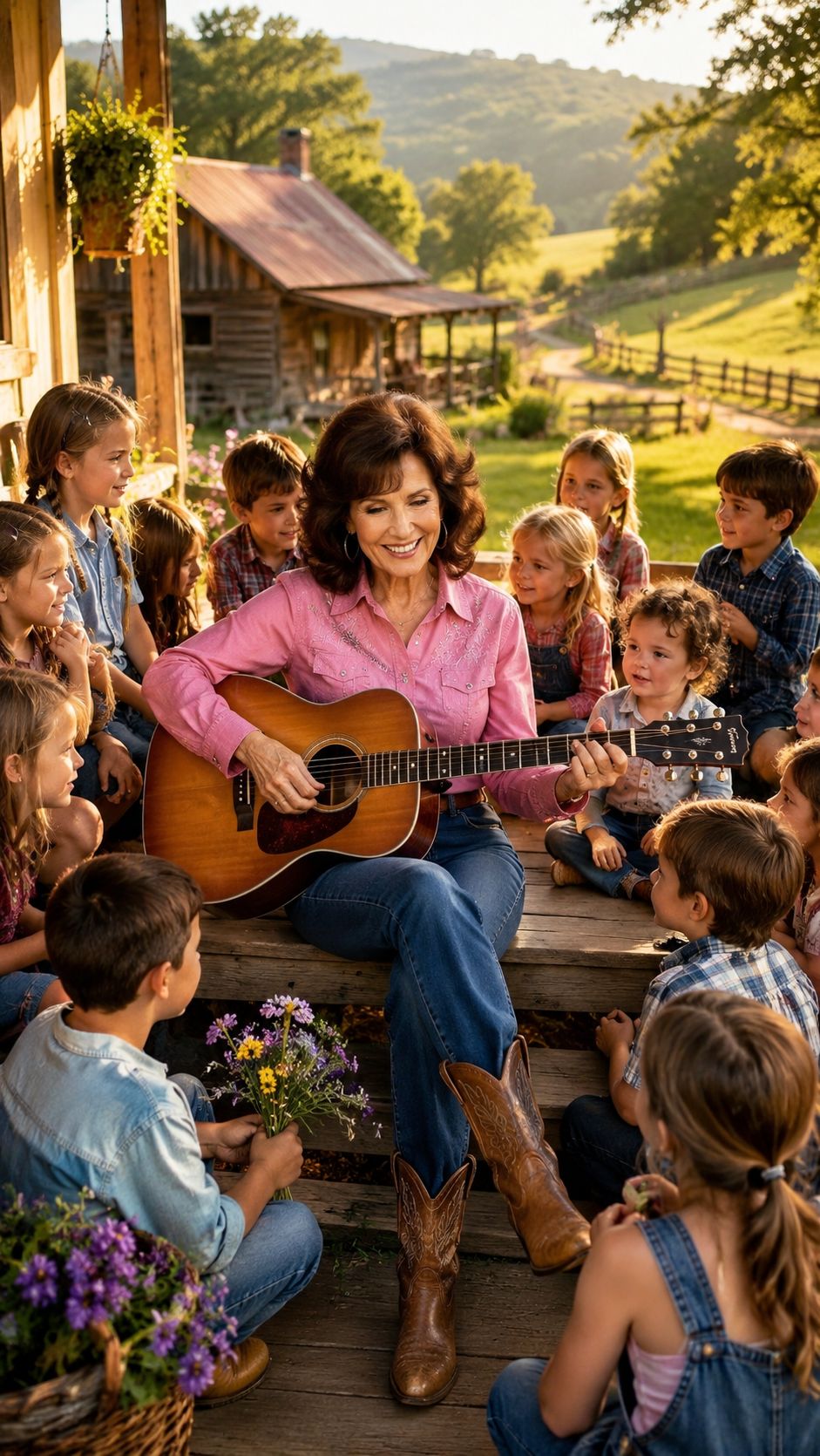
There was a time when Loretta Lynn could step onto a stage anywhere in America and command the attention of thousands.
Her voice carried the weight of coal mines, marriage, motherhood, heartbreak, faith, hard work, and survival. She became one of country music’s most important voices not because she tried to sound larger than life, but because she sang about ordinary life with extraordinary honesty.
Yet in the final chapter of her remarkable life, the legendary singer found herself drawn away from the bright lights.
Back home.
Back at Hurricane Mills, the sprawling Tennessee ranch that had become far more than a piece of property.
It was where Loretta could be a mother.
A grandmother.
A great-grandmother.
And simply “Memaw.”
When Loretta Lynn died peacefully in her sleep at her beloved ranch on October 4, 2022, at the age of 90, the world lost a country music giant. But the woman who left this world was surrounded by the place and the people who had always mattered most to her. Her family confirmed that she died at home at the ranch in Hurricane Mills.
And that detail says something profound about Loretta Lynn.
For decades, the world knew her as a superstar.
Her family knew her as home.
The Woman Behind the Legend
Loretta’s story had never been an ordinary one.
Born in Butcher Hollow, Kentucky, she grew up in a large working-class family before becoming one of the most successful women in country music history. Her career eventually produced iconic songs such as “Coal Miner’s Daughter,” “You Ain’t Woman Enough,” and “The Pill,” while her songwriting helped redefine what a woman could say in country music.
She earned major awards, entered the Country Music Hall of Fame, received the Presidential Medal of Freedom, and sold more than 45 million records worldwide.
But fame came with a price.
Loretta spent years traveling, performing, recording and living much of her life on the road. Her own family later recalled how difficult her touring schedule could be. In a CBS interview, Loretta openly acknowledged the loneliness and complicated realities of balancing motherhood with a career that demanded so much time away from home.
That is why the later years at Hurricane Mills feel so meaningful.
The woman who once spent hundreds of days a year working was finally able to spend more time simply being present.
And for Loretta, presence meant family.
Hurricane Mills Was More Than a Ranch
To outsiders, Hurricane Mills was a legendary country music destination.
To Loretta Lynn, it was home.
The property became a place where her history, family, music and rural roots could exist side by side.
There were memories everywhere.
There were horses and fields.
There were family photographs.
There were stories.
There were generations of Lynns coming and going.
And then there were the grandchildren.
Loretta was survived by 25 grandchildren, with one grandchild, Jeffrey Allen Lynn, having died in 2016. Her official family records list 26 grandchildren in total.
That enormous family became one of the great joys of her later life.
Loretta’s grandchildren affectionately called her Memaw, and the ranch became a gathering place where generations could reconnect.
Christmas was especially important.
The family traditionally gathered at the ranch, where Loretta served food, shared prayers and celebrated with the people she loved. Her famous chicken and dumplings became part of those family traditions.
For someone who had once worried about missing Christmas morning because she was stuck on the road, those family gatherings carried enormous emotional weight.
She knew what it meant to miss home.
So when she could finally stay home, she treasured it.
“Grand Central Station” — But She Loved Every Minute
Imagine the ranch filled with children, grandchildren and great-grandchildren.
Doors opening.
People talking.
Laughter traveling through the house.
Food being prepared.
Stories being repeated.
Someone sitting on the porch.
Someone else heading outside.
That was the kind of chaos Loretta loved.
Accounts of her family life describe the ranch as almost like “Grand Central Station” when everyone gathered. Instead of complaining about the noise or crowds, Loretta embraced it.
Why?
Because she had grown up surrounded by family.
She understood the value of belonging.
And perhaps more than anything else, she wanted the generations that came after her to experience that same sense of connection.
“Family was Lynn’s biggest priority.”
That idea may be more important to understanding Loretta Lynn than any chart position or award.
She could have spent her final years surrounded exclusively by memorabilia from her extraordinary career.
Instead, she wanted people.
The Simple Things Meant Everything
Loretta didn’t need a sold-out arena to feel important anymore.
Some of her favorite moments were remarkably simple.
Fishing.
Sitting on the porch.
Laughing with family.
Hugging her grandchildren.
Working with food.
Canning and pickling.
Making fried chicken.
These were the ordinary activities that connected her to the Kentucky girl she had been long before the world knew her name.
That contrast makes her final chapter particularly moving.
The woman who had performed for presidents and millions of fans could still find happiness in a porch conversation with a grandchild.
The woman who had spent decades being photographed in glamorous costumes could still be perfectly content in the kitchen.
The woman who had become an international symbol of country music remained deeply connected to the rural traditions that shaped her.
That authenticity was one of the secrets of Loretta’s longevity.
She never completely left the woman from Butcher Hollow behind.
A Family Carrying the Music Forward
Loretta’s influence didn’t stop with her own generation.
Several members of her family became involved in music, including daughters and grandchildren.
Her granddaughter Tayla Lynn pursued a career in country music, while another granddaughter, Emmy Russell, later introduced Loretta’s musical legacy to a new generation through her own performances and appearance on American Idol.
That makes Loretta’s legacy feel almost circular.
The songs she once wrote about her own life became part of the lives of her descendants.
Her stories became their inheritance.
Her music became their vocabulary.
Her ranch became a physical reminder of where they came from.
And perhaps that was Loretta’s greatest achievement.
Not merely that she became famous.
But that she created something her family could carry forward.
The Losses She Carried
Loretta’s final years weren’t without heartbreak.
She had already experienced devastating losses.
Her son Jack Benny died in 1984 after drowning in an accident at the family ranch. Her daughter Betty Sue died in 2013. Then, in 2016, her grandson Jeffrey Allen Lynn died unexpectedly.
Those losses were woven into the fabric of her later life.
Loretta understood that growing older meant watching the family tree change.
Some branches disappeared.
Others grew.
Children became parents.
Grandchildren became adults.
And new great-grandchildren arrived.
The ranch therefore wasn’t simply a place of celebration.
It was also a place where memories lived.
Every corner could carry a story.
Every family gathering could remind her of someone who was no longer there.
Yet she continued gathering the family around her.
That resilience was pure Loretta Lynn.
“Coming Into the Light”
In stories about Loretta’s final years, her reflections on mortality and faith have drawn particular attention.
The phrase “coming into the light” captures something deeply connected to the final chapter of her life: the sense that after decades of struggle, work, loss and triumph, Loretta was becoming increasingly reflective about what came next.
She had already lived several lifetimes.
She had known poverty.
She had known fame.
She had known marriage and motherhood.
She had known enormous success.
She had known grief.
She had known disappointment.
And she had survived it all.
By the time she entered her final years, there was little left to prove.
The world already knew who Loretta Lynn was.
What mattered now was who was sitting beside her.
Her Final Homecoming
When the news came on October 4, 2022, that Loretta had died peacefully in her sleep at Hurricane Mills, the location itself seemed almost symbolic.
She had spent her life traveling away from home so that she could build a life for the people she loved.
In the end, she was home.
Her family announced that she had passed peacefully at her beloved ranch.
There was something almost poetic about that ending.
No stadium.
No flashing cameras.
No roaring crowd.
Just home.
The ranch.
The family.
The memories.
The land.
And the legacy.
“She wasn’t just a country music legend. She was Memaw.”
That may be the simplest way to understand the woman behind the legend.
Millions knew Loretta Lynn.
But her grandchildren knew another Loretta.
The woman who hugged them.
The woman who cooked for them.
The woman who laughed with them.
The woman who sat on the porch.
The woman whose home became a gathering place.
The woman who wanted her family close.
The Legacy That Will Not Disappear
Loretta Lynn’s death closed one chapter of country music history, but it did not erase her presence.
Her songs remain.
Her voice remains.
Her stories remain.
And most importantly, her family remains.
The surviving grandchildren and later generations carry pieces of her personality, her music and her memories into the future.
That is why Loretta’s final years deserve to be remembered not simply as the twilight of a superstar.
They were the final pages of a woman’s life who had spent decades giving herself to audiences — and eventually found her deepest happiness in giving her time to family.
At Hurricane Mills, the applause became quieter.
The crowds became smaller.
The stage lights faded.
But something more meaningful took their place.
A porch.
A kitchen.
A fishing spot.
A family table.
A grandmother surrounded by generations of people who knew her not because she was famous, but because she was theirs.
And perhaps that is the most beautiful ending a country legend could have.
Loretta Lynn spent a lifetime singing about home.
In the end, she got to spend her final days there.
And when she finally left this world, she left behind something far more enduring than records or trophies.
She left behind a family who could tell her story.
A ranch filled with memories.
And songs that will continue reminding generations of the woman who turned the struggles of ordinary life into some of country music’s most extraordinary truths.
Because long after the last note fades, Loretta Lynn’s greatest song may have been the life she built around the people she loved.
VIDEO: