 By admin
 INTRODUCTION:
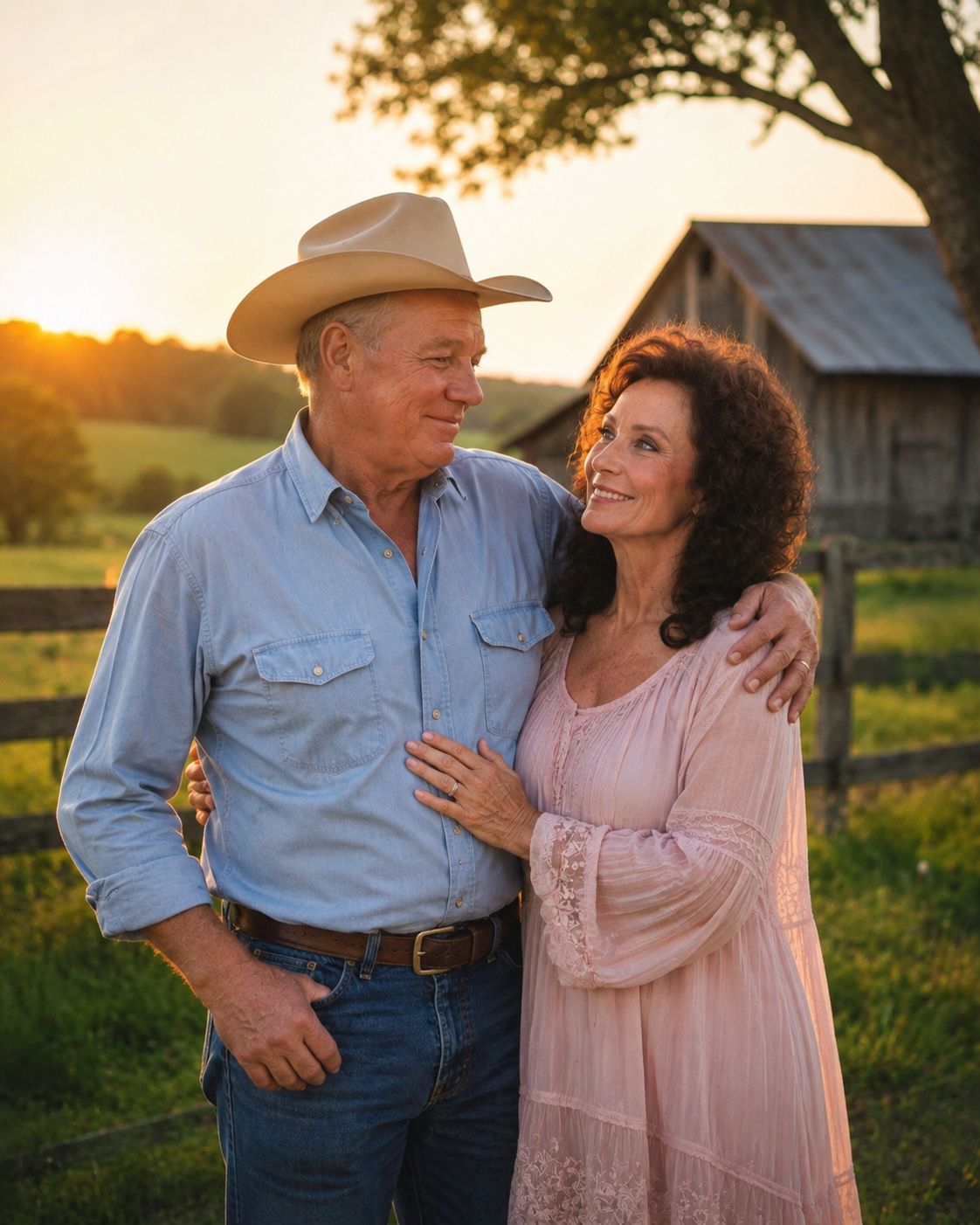
There are love stories built for movies, with perfect endings, beautiful promises, and couples who seem untouched by the messiness of real life.
Then there was Loretta Lynn and Oliver “Doo” Lynn.
Their story was never that kind of romance.
It was louder. Rougher. More complicated. Sometimes heartbreaking. Sometimes tender. And, above all, real.
When Loretta married Oliver in 1948, she was only 15. The young couple would go on to have six children and remain married until Oliver’s death in 1996—a 48-year relationship that became one of the most complicated and unforgettable marriages in country music history.
But what makes their story so fascinating isn’t simply that they stayed together.
It’s that Loretta Lynn never tried to rewrite the difficult parts.
She didn’t turn Oliver into a perfect husband for the sake of a prettier story. She didn’t pretend their marriage was always peaceful. Instead, she took the arguments, disappointments, jealousy, laughter, loyalty, drinking, infidelity, family struggles, and heartbreak—and somehow turned them into songs that millions of people recognized as their own lives.
That honesty became part of her legend.
A Teenage Bride With No Idea What Her Life Would Become
Loretta Webb came from Butcher Hollow, Kentucky, the daughter of a coal miner and one of eight children.
In 1948, she married Oliver Lynn, known by nicknames including “Doo,” “Doolittle,” and “Mooney.” They soon left Kentucky for Washington, where they tried to build a life far away from home.
The young bride could hardly have imagined that the man standing beside her would eventually become both the most complicated figure in her personal life and one of the people who helped push her toward becoming a country music legend.
By the time Loretta was 20, she had already become a mother of four. Eventually, she and Oliver would have six children.
There were bills.
There were babies.
There were lonely nights.
There were arguments.
And there was music.
Oliver recognized something in Loretta that she herself wasn’t yet sure existed.
He bought her a guitar and encouraged her to sing. Later, he pushed her toward performing in local venues and radio appearances, even though she was terrified of being onstage. Loretta eventually credited that determination with helping launch the career that would make her one of country music’s defining voices.
“I could never have done it on my own.”
That doesn’t mean the marriage was easy.
It means reality was more complicated than a simple good-husband/bad-husband story.
The Man Behind the Songs
If you want to understand Loretta Lynn’s songwriting, you have to understand the life she was living.
Oliver drank.
He was unfaithful.
Their relationship could become volatile, and Loretta later spoke openly about physical fights and painful episodes in their marriage. CBS reported that Lynn described a husband who drank, cheated, spent her money, and abused her—while also saying that she loved him and believed he loved her.
That contradiction is essential.
Because Loretta didn’t write about marriage from some distant, polished perspective.
She wrote from inside it.
She wrote about the man who could make her furious and the same man who helped put a guitar in her hands.
She wrote about betrayal while living through a marriage that lasted nearly half a century.
And she wrote about women who were tired of pretending everything was fine.
Songs such as “Don’t Come Home A-Drinkin’ (With Lovin’ on Your Mind)”, “Fist City,” and “You Ain’t Woman Enough” weren’t abstract exercises in songwriting. They drew heavily from the emotional world around her.
Loretta once explained that Oliver would try to figure out which lines in her songs were about him.
Her answer, in essence, was that he had plenty of reasons to wonder.
“Those songs was true to life. We fought hard, and we loved hard.”
That sentence may explain their entire marriage better than any romantic biography ever could.
She Didn’t Hide the Ugly Parts
This is where Loretta Lynn was different.
At a time when women in country music were often expected to protect the image of the family, Loretta turned private pain into public art.
She didn’t sanitize marriage.
She didn’t make herself the helpless heroine.
And she didn’t pretend every argument ended with an apology and a kiss.
Instead, she sang what many women were thinking but were afraid to say.
Her songs could be funny, furious, rebellious, vulnerable, and deeply personal—all within the same career.
The result was revolutionary.
Women heard themselves in Loretta.
They heard the wife waiting for a husband who had been drinking.
They heard the woman warning another woman away from her man.
They heard the exhausted mother.
They heard the wife who was angry but still loved her husband.
And they heard someone saying: real life is messy, and that doesn’t make your feelings any less real.
Love Doesn’t Always Look Like a Fairy Tale
Modern audiences sometimes struggle with the idea of Loretta remaining married to Oliver despite everything that happened.
And it’s understandable.
Some of the behavior she described should not be romanticized.
Infidelity and abuse are not evidence of a healthy relationship, and Loretta herself later acknowledged just how difficult her life had been. In one CBS interview, she reflected on the loneliness and hardships that accompanied both her marriage and her extraordinary success.
So the lesson isn’t that people should tolerate mistreatment because “true love” requires it.
The more interesting lesson is that human relationships cannot always be reduced to one label.
Oliver could hurt Loretta.
He could frustrate her.
He could disappoint her.
He could also encourage her music, travel beside her, help manage her career, and remain the person whose opinion mattered to her.
Those truths existed simultaneously.
And Loretta was courageous enough to leave them that way.
The Guitar That Changed Everything
Perhaps the most symbolic object in their entire story wasn’t a wedding ring.
It was a guitar.
Oliver bought Loretta a $17 Harmony guitar and pushed her to learn to play and perform. That small purchase helped open a door to a career that would eventually include chart-topping records, the Grand Ole Opry, the Country Music Hall of Fame, Grammy recognition, and a place among the most influential women in country music.
Think about the irony.
The same marriage that produced some of Loretta’s deepest wounds also helped create the circumstances in which her voice could emerge.
That’s not a contradiction to erase.
That’s the story.
Loretta didn’t become Loretta Lynn because her life was perfect.
She became Loretta Lynn because she told the truth about an imperfect life.
48 Years Later, the Story Still Had No Simple Ending
Oliver died in 1996 after health complications.
Their marriage ended only because his life did.
Loretta later spoke about how difficult it was to suddenly make decisions without the man she had spent nearly five decades beside.
“I miss everything about him.”
The words are devastating precisely because they came after everything.
After the fights.
After the betrayals.
After the songs.
After the years.
After the children had grown.
After the career.
After the arguments that had become part of their legend.
She still missed him.
That doesn’t erase what happened.
It reveals something else: grief doesn’t organize itself according to logic.
You can miss someone who hurt you.
You can love someone who disappointed you.
You can be angry with someone and still feel the world become strangely empty when they’re gone.
Loretta understood that better than most.
Her Marriage Became Her Musical Language
Perhaps the greatest legacy of Loretta and Oliver’s relationship wasn’t the marriage itself.
It was what Loretta created from it.
She transformed domestic arguments into anthems.
She transformed jealousy into storytelling.
She transformed frustration into laughter.
She transformed pain into songs that outlived both of them.
And she gave country music something it desperately needed: a woman’s unfiltered perspective.
That is why songs like “Don’t Come Home A-Drinkin’” still resonate.
They aren’t museum pieces.
They are emotional photographs.
They capture a woman standing in a kitchen, waiting for a husband to come through the door, already knowing what kind of night it might become.
They capture the anger.
The sarcasm.
The love.
The exhaustion.
The stubbornness.
The hope.
Everything.
The Greatest Love Story Was the One She Refused to Perfect
Loretta Lynn’s relationship with Oliver wasn’t the greatest love story because it was flawless.
It wasn’t.
It was one of the greatest because she never needed to pretend that it was.
She let the contradictions remain.
She let the scars remain.
She let the laughter remain.
She let the songs tell the truth.
And maybe that’s why her story still feels so powerful decades later.
In an industry filled with carefully manufactured images, Loretta offered something much rarer:
the truth of a woman who had lived.
Her 48 years with Oliver weren’t a fairy tale.
They were six children, poverty, ambition, music, arguments, forgiveness, heartbreak, laughter, loyalty, and loss—all tangled together.
And when she finally looked back, she didn’t need to call it perfect.
She only needed to call it hers.
Loretta Lynn never promised that love would be easy. She showed the world that real love could be complicated, imperfect, painful, funny, unforgettable—and still become the story you carry for the rest of your life.
That may be the most country love story of all.
Not because it ended happily.
Not because it was without pain.
But because for 48 years, Loretta Lynn kept telling the truth about it.
VIDEO: