 By admin
 INTRODUCTION:
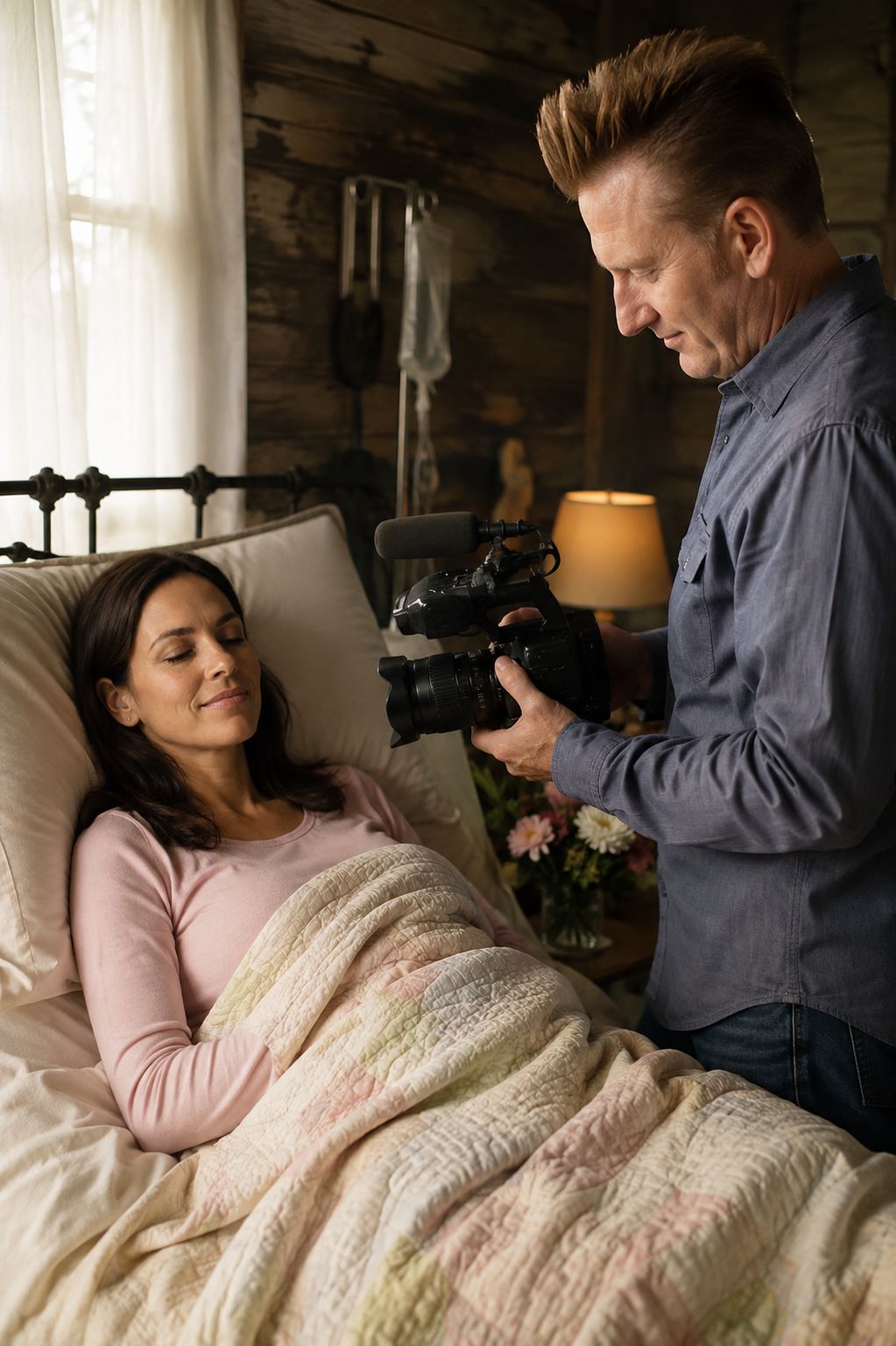
There are moments in life when even the camera feels too heavy to hold.
For Rory Feek, those moments came during the devastating final chapter of his wife Joey Feek’s life. What began as an ordinary attempt to document a young family’s journey slowly became something far more profound: a record of love, faith, illness, motherhood, marriage, and an approaching goodbye that neither husband nor wife wanted to believe was coming.
The story behind Rory’s decision to keep filming is not simply about country music or celebrity. It is about what a person does when the future suddenly becomes uncertain—and whether faith can give someone the courage to keep looking forward while everything they love seems to be slipping away.
Joey died on March 4, 2016, at age 40, after battling cervical cancer. In the months leading up to her death, Rory openly documented their family’s experience through his blog and later through the documentary To Joey, With Love. The footage captured not only Joey’s illness, but the life that existed around it: their daughter Indiana, their marriage, their farm, their music, their prayers, and the small moments that suddenly carried enormous meaning.
And that is what makes the footage so powerful.
It wasn’t merely footage of someone dying.
It was footage of someone living.
The Camera Was There Before the Tragedy
One of the most haunting details in Rory’s story is that the camera began rolling before he knew exactly what the future would hold.
Rory later explained that he and Joey had decided to step away from their television show and performing schedule in early 2014 because they were preparing for the arrival of their baby. They imagined simplifying their lives and documenting their first year as a family.
Then life took an unexpected turn.
Their daughter Indiana was born with Down syndrome. Not long afterward, Joey was diagnosed with cervical cancer.
The family had planned a story about new beginnings.
Instead, they found themselves living inside a story about love and loss.
Rory later reflected that he had felt an almost inexplicable need to capture their lives on film before he understood why that footage would become so important.
“Record this.”
That simple instinct became one of the most consequential decisions Rory ever made.
Years later, those recordings would allow him—and eventually Indiana—to see Joey not merely as the woman who became sick, but as the vibrant wife and mother she had been before cancer consumed so much of their lives.
He Wasn’t Just Recording a Goodbye
This distinction matters.
It would be easy to look at the footage and say Rory was documenting Joey’s final days.
But Rory himself wanted audiences to understand something deeper.
He wanted people to see Joey living.
In his reflections surrounding To Joey, With Love, Rory explained that many people had become familiar with the painful final months of Joey’s battle. They had seen the hospital bed, the difficult decisions, the prayers, and the heartbreak.
But he wanted them to know the woman behind the tragedy.
“I’d like for people to have the chance to see my wife live.”
That idea changes everything.
The camera wasn’t simply an observer of death.
It became a witness to life.
There were smiles. There were ordinary conversations. There were moments with Indiana. There was music. There was family. There were days when nobody knew what the next week would bring.
And perhaps that is why the footage has resonated so strongly with people who never knew Joey personally.
Because grief is rarely about one dramatic moment.
Grief is remembering thousands of ordinary moments that suddenly become priceless.
Faith Didn’t Mean Rory Expected a Miracle
One of the most misunderstood aspects of Rory’s story is his faith.
For some people, faith means believing that everything will eventually turn out exactly as hoped.
But Rory’s experience became something more complicated.
He prayed for Joey.
He hoped for healing.
He believed in God’s power.
But he also had to confront the possibility that the answer to his prayers might not be the answer he wanted.
In an interview after Joey’s death, Rory explained that his faith had not disappeared simply because events had not unfolded according to his wishes.
“Just because things don’t work out the way that you hoped they would, doesn’t mean that God isn’t still in charge.”
That may be the central idea behind the entire story.
Rory wasn’t filming because he was certain Joey would survive.
He was filming because he believed her life mattered regardless of how the story ended.
That is a very different kind of faith.
The Longest Goodbye Was Also a Love Story
Cancer tends to reduce a person to medical terminology.
Diagnosis.
Treatment.
Surgery.
Remission.
Recurrence.
Terminal.
But Rory’s camera resisted that reduction.
Joey was still a wife.
Still a mother.
Still a singer.
Still a woman who laughed.
Still the person Rory loved.
The footage preserved those identities when cancer threatened to overwhelm them.
That may explain why To Joey, With Love became more than a documentary about illness. It became a portrait of a marriage.
Christianity Today described the film as a story of faith, heartbreak, and the final years of the couple’s life together.
And the emotional power came from the fact that audiences already knew how the story ended.
There was no mystery.
There was no surprise ending waiting around the corner.
Everyone knew Joey would die.
And yet people kept watching.
Why?
Because the value was not in discovering whether Joey survived.
The value was in seeing how she lived while she was still here.
Indiana Became Part of the Legacy
Perhaps the most heartbreaking reason for preserving the footage was Indiana.
When Joey died, Indiana was still a very young child.
She would grow up without the ordinary memories many children take for granted—the sound of their mother’s voice in the kitchen, the way she moved through a room, the little expressions on her face, the everyday rhythm of family life.
But Rory had something.
He had the camera.
He had recordings of Joey laughing.
He had her singing.
He had moments of her with Indiana.
He had pieces of a childhood that could otherwise have existed only in photographs and stories told by other people.
Rory later described the old footage as a gift because it allowed his family to preserve Joey’s presence in a tangible way.
That is perhaps the most beautiful argument for documenting life.
Sometimes we don’t know what we are saving until years later.
The Music Became Another Form of Memory
The same principle extended to music.
Joey and Rory’s final album together, Hymns That Are Important to Us, became deeply connected to their story. Joey lived long enough to see its remarkable success, and Rory later spoke about continuing to listen to the record with Indiana.
Music gave them another way to keep Joey present.
A photograph captures a face.
A video captures movement.
But a song can bring back an entire emotional world.
For Rory, those hymns were not simply recordings.
They were reminders.
They were memories.
They were pieces of Joey that could still fill a quiet room.
Sometimes keeping someone alive in your heart means refusing to erase the things that remind you of them.
Rory chose remembrance over avoidance.
And that choice is one of the most emotionally powerful elements of his story.
Why Keep the Cameras Rolling When Everything Hurts?
There is another question hiding beneath the entire story.
Why would someone continue filming when the person they love is dying?
Why not put the camera down?
Why not protect the privacy of the final days?
There is no single answer.
For Rory, it appears to have been a combination of instinct, faith, love, and the understanding that these moments might someday become priceless.
He was not simply creating content.
He was creating a family archive.
He was preserving evidence that Joey existed exactly as she was—not just as the woman remembered through tragedy.
And perhaps most importantly, he was documenting a lesson he himself was still learning:
Life doesn’t become meaningless because it ends.
Sometimes its temporary nature is exactly what makes every moment precious.
A Story That Continued After Joey
Rory’s camera did not stop when Joey died.
The story changed.
The man who once documented his marriage now had to document fatherhood without his wife.
He had to raise Indiana.
He had to navigate grief.
He had to figure out what life looked like after the woman who had shared so much of it was gone.
In later years, Rory continued writing about the journey of raising Indiana and preserving memories of Joey. His This Life I Live project eventually evolved into a documentary-style series designed to capture the lives of Rory, Indiana, his older daughters, and the people around them.
That decision reveals something important.
The camera was never really about death.
It was about continuity.
One chapter ended.
Another began.
And Rory wanted to remember both.
The Meaning of Faith After the Miracle Doesn’t Come
The most profound part of Rory Feek’s story may not be that he believed in God during Joey’s illness.
Millions of people pray during tragedy.
The harder question comes afterward.
What happens when the prayer isn’t answered in the way you wanted?
What happens when the person you begged God to save is gone?
Rory’s answer was not to abandon faith.
Instead, he continued forward with the belief that there was meaning beyond what he could immediately understand.
That doesn’t make grief disappear.
It doesn’t make the empty chair disappear.
It doesn’t make birthdays easier.
It doesn’t erase the sound of a loved one’s voice from memory.
But it can provide a framework for continuing.
And perhaps that is why the cameras kept rolling.
Because Rory wasn’t trying to prove that tragedy wasn’t happening.
He was trying to show that love was still happening too.
The Legacy of the Longest Goodbye
Years after Joey’s death, the footage remains powerful because it refuses to give tragedy the final word.
Cancer was part of Joey’s story.
But it was never all of her story.
She was a singer.
A wife.
A mother.
A daughter.
A friend.
A woman of faith.
And for Rory, she was the love of his life.
The camera preserved all of those things.
That is why To Joey, With Love feels less like a memorial and more like an act of remembrance. Rory wanted audiences to experience the beauty before the heartbreak—to understand that the woman they mourned was once laughing, singing, loving, dreaming, and holding her daughter.
The goodbye was devastating.
But the life that came before it was beautiful.
And perhaps that is the greatest lesson Rory left behind.
Faith does not always mean believing you will get the ending you prayed for. Sometimes faith means believing that the love, the memories, and the life you shared still mattered—even when the ending breaks your heart.
Rory kept the cameras rolling because someday Indiana would need to see her mother.
Because someday the world might need to remember Joey as more than a cancer victim.
And perhaps because, in the middle of the darkest season of his life, Rory understood something that many of us only learn after loss:
You cannot stop time.
But you can preserve a moment.
You can preserve a voice.
You can preserve a smile.
And when the goodbye finally comes, you can carry those pieces of love with you.
That was the power behind Rory Feek’s camera.
It didn’t stop the tragedy.
It simply made sure that tragedy would never be the only thing left behind.
VIDEO: