 By admin
 INTRODUCTION:
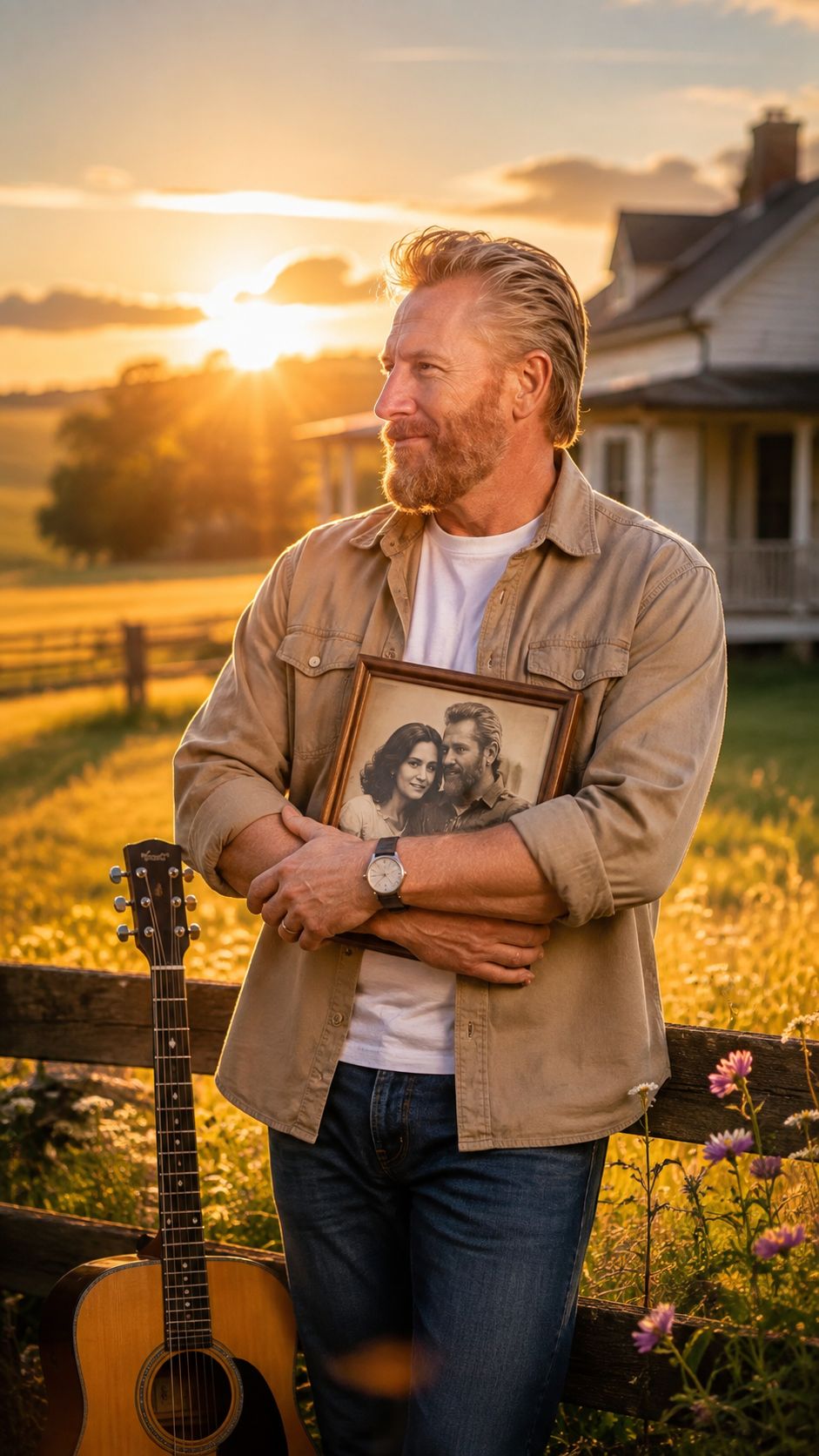
There are love stories that begin with a song.
There are love stories that begin with a chance meeting.
And then there are love stories so powerful that even death cannot bring them to an end.
The story of Rory Feek and Joey Feek belongs in that final category.
For country music fans, their names became inseparable. Rory and Joey were not simply a husband-and-wife singing duo. They became symbols of devotion, family, faith, heartbreak, and the extraordinary strength it can take to keep loving someone after they are gone.
But behind the music, behind the photographs, behind the applause, was a deeply personal story that would eventually become one of country music’s most heartbreaking journeys.
And at the center of it was a man trying to answer an impossible question:
How do you keep loving someone when you can no longer hold their hand?
A LOVE THAT STARTED WITH SOMETHING ORDINARY
Before the heartbreak, there was an ordinary beginning.
Rory has written extensively about how he first met Joey, describing the moment she walked into his life in 2001 with a simple introduction: “Hi, I’m Joey.”
That seemingly small encounter would change everything.
Years later, their relationship became a marriage, a family, a musical partnership, and eventually a story shared with millions.
Rory has often described Joey’s approach to love as something practical and deeply personal. She wasn’t necessarily looking for grand gestures. She expressed love through service—through cooking, helping, caring, and the countless little things that make a home feel like home.
Rory learned to meet her there.
He wrote about fixing things around the house, taking care of the yard, and helping create a life where Joey could remain close to home while continuing her music career.
It wasn’t Hollywood romance.
It was something quieter.
And perhaps that is exactly why it resonated so deeply.
“She showed you how much she loved you by serving you.”
That kind of love doesn’t disappear when the cameras stop rolling.
It becomes part of who you are.
THEN EVERYTHING CHANGED
In 2014, Rory and Joey welcomed their daughter, Indiana.
What should have been a peaceful new chapter quickly became complicated. Indiana was born with Down syndrome, and not long afterward, Joey received devastating news: she had cervical cancer.
Rory later described the moment they learned about the diagnosis as surreal.
The doctor was crying.
Joey remained brave.
And suddenly, the future they had imagined looked completely different.
Rory recalled how Joey’s first concern wasn’t herself.
It was their baby.
That detail says almost everything about the woman Rory loved.
Even while confronting her own mortality, Joey’s thoughts turned toward her child.
The family entered a painful period of surgeries, treatments, hospital stays, uncertainty, prayer, and exhausting travel.
And through it all, Rory stayed beside her.
Their story stopped being about fame.
It became about time.
How much time did they have?
How should they spend it?
What memories could they preserve?
And what would remain after the final goodbye?
“WHEN I’M GONE” BECAME SOMETHING MORE
Perhaps the most haunting chapter of their story involves the song “When I’m Gone.”
Years before Joey’s death, Rory and Joey filmed a music video imagining a future in which Rory was living alone at their farmhouse while Joey was buried in the grove behind their home.
At the time, it was a story.
A fictional scenario.
They could not have known how painfully close it would eventually come to reality.
Rory later wrote that, several years afterward, the imagined future became real.
Joey died in March 2016.
Rory was left at the farm with their young daughter, Indiana.
The song suddenly wasn’t fiction anymore.
It was life.
And that is one of the most devastating elements of their story: sometimes art predicts the emotions we don’t yet understand.
The couple had created something about separation before they knew what separation would truly mean.
Years later, Rory revisited that old footage and reflected on how different the words sounded after Joey was gone.
“We had no idea what it would mean to us and so many others a few short years later.”
Imagine watching a video of yourself and your wife imagining the very future you eventually had to live.
That isn’t simply nostalgia.
That’s grief confronting memory.
THE FARMHOUSE BECAME A PLACE OF MEMORY
After Joey’s death, Rory did not simply walk away from their shared life.
The farmhouse remained.
The fields remained.
The memories remained.
And, most painfully, Joey’s absence remained.
Rory has written about sitting near the wooden cross marking Joey’s resting place, talking to her, praying, remembering, and trying to make sense of what had happened.
One of his most emotional reflections came around their wedding anniversary.
He described carrying a thermos and their favorite mugs across the field at sunrise, sitting near the cross, and talking to Joey.
She couldn’t answer.
But he still talked.
That detail captures something profound about grief.
Love doesn’t necessarily stop when communication becomes impossible.
Sometimes you continue talking because the relationship still exists inside you.
The person is gone.
But the love remains.
HE DIDN’T WANT THE WORLD TO ONLY SEE JOEY DIE
There is another important part of Rory’s story that is easy to overlook.
He didn’t want Joey’s legacy to become only the story of cancer.
He wanted people to remember her life.
Her laughter.
Her marriage.
Her motherhood.
Her music.
Her ordinary days.
Her extraordinary courage.
Rory had recorded extensive footage of their family life, and he eventually helped transform that material into the documentary “To Joey, With Love.”
The purpose was bigger than simply preserving memories.
He wanted people to see Joey living—not only Joey suffering.
He wanted audiences to understand the woman before the diagnosis.
The wife before the hospital room.
The mother before the final goodbye.
The musician before the illness.
That distinction matters.
Because a person’s final chapter should never erase all the chapters that came before it.
TRUE LOVE DOESN’T MEAN NEVER MOVING FORWARD
Perhaps the most misunderstood part of Rory’s story is what happened after Joey.
Moving forward does not necessarily mean moving on.
Those are two very different things.
Moving on can sound like leaving someone behind.
Moving forward can mean carrying their memory with you while continuing to live.
Rory became a father navigating life with Indiana.
He continued writing.
He continued sharing stories.
He continued creating music.
And he continued trying to understand what his life was supposed to become.
In one of his reflections, Rory described loving Joey as something that had been relatively easy because their lives and beliefs aligned so closely. The harder challenge came afterward—learning how to love his children and navigate difficult circumstances while becoming a better man.
That may be the greatest legacy of Joey’s life.
Not that Rory remained frozen in grief.
But that her love continued influencing how he lived.
“I choose to love her. To love them. Period. End of story.”
Those words reveal something much bigger than romance.
They reveal a philosophy.
Love isn’t only something we feel when life is easy.
Sometimes love is a decision we make when life becomes painfully complicated.
YEARS LATER, THE STORY IS STILL BEING WRITTEN
Rory’s journey did not end with Joey’s death.
It continued through fatherhood, music, writing, faith, family changes, and new chapters.
Even in 2026, Rory continues sharing pieces of his life publicly. His recent writing reflects another major transition: leaving the farm life he had known for decades and beginning a new season in Texas.
That evolution is important.
Because grief isn’t a straight road.
There is no moment when someone simply wakes up and says, “I’m finished missing them.”
Instead, memories become woven into ordinary life.
A song can bring them back.
A photograph can bring them back.
A familiar place can bring them back.
A child’s smile can bring them back.
And sometimes, even decades later, love can still feel surprisingly close.
THE REAL LESSON OF RORY AND JOEY
The devastating story of Rory Feek and Joey Feek isn’t ultimately a story about death.
It is a story about what survives death.
The music survives.
The photographs survive.
The stories survive.
Their daughter carries pieces of her mother forward.
Their family carries memories forward.
And Rory carries a love that changed him forever.
That is why their story continues to move country music fans.
Because many people have experienced loss.
Many people have stood beside a hospital bed.
Many have sat in an empty room after someone they loved was gone.
Many have wondered how the world can possibly continue turning when their own world has stopped.
Rory’s story offers no simple answer.
Instead, it offers something more honest:
You keep going.
You remember.
You grieve.
You laugh again when you didn’t think you could.
You cry again when you thought you were finished crying.
And eventually, you understand that continuing to live isn’t a betrayal of the person you lost.
It can be one of the greatest ways to honor them.
Rory once described the hope that Joey’s story could continue to live through film, memories, family, and the people she touched. His words capture the central truth of their journey: a person’s physical presence can disappear while their influence continues shaping the lives of everyone who loved them.
And perhaps that is why the story still hurts.
Because it was real.
It wasn’t a perfect fairytale.
It wasn’t a Hollywood ending.
It was two people who found each other, built a family, faced something unimaginably difficult, and tried to love each other through every second they were given.
Joey’s life ended.
But the love story didn’t.
It changed form.
It became memory.
It became music.
It became photographs.
It became stories told by a husband who still remembers the woman who changed his life.
And perhaps that is the most beautiful—and heartbreaking—truth of all:
True love doesn’t always get to stay beside you. Sometimes it becomes the part of you that stays forever.
That is the legacy of Rory and Joey Feek.
Not simply that they loved each other.
But that after everything was taken from them, love was the one thing death could not take away.
VIDEO: