 By admin
 INTRODUCTION:
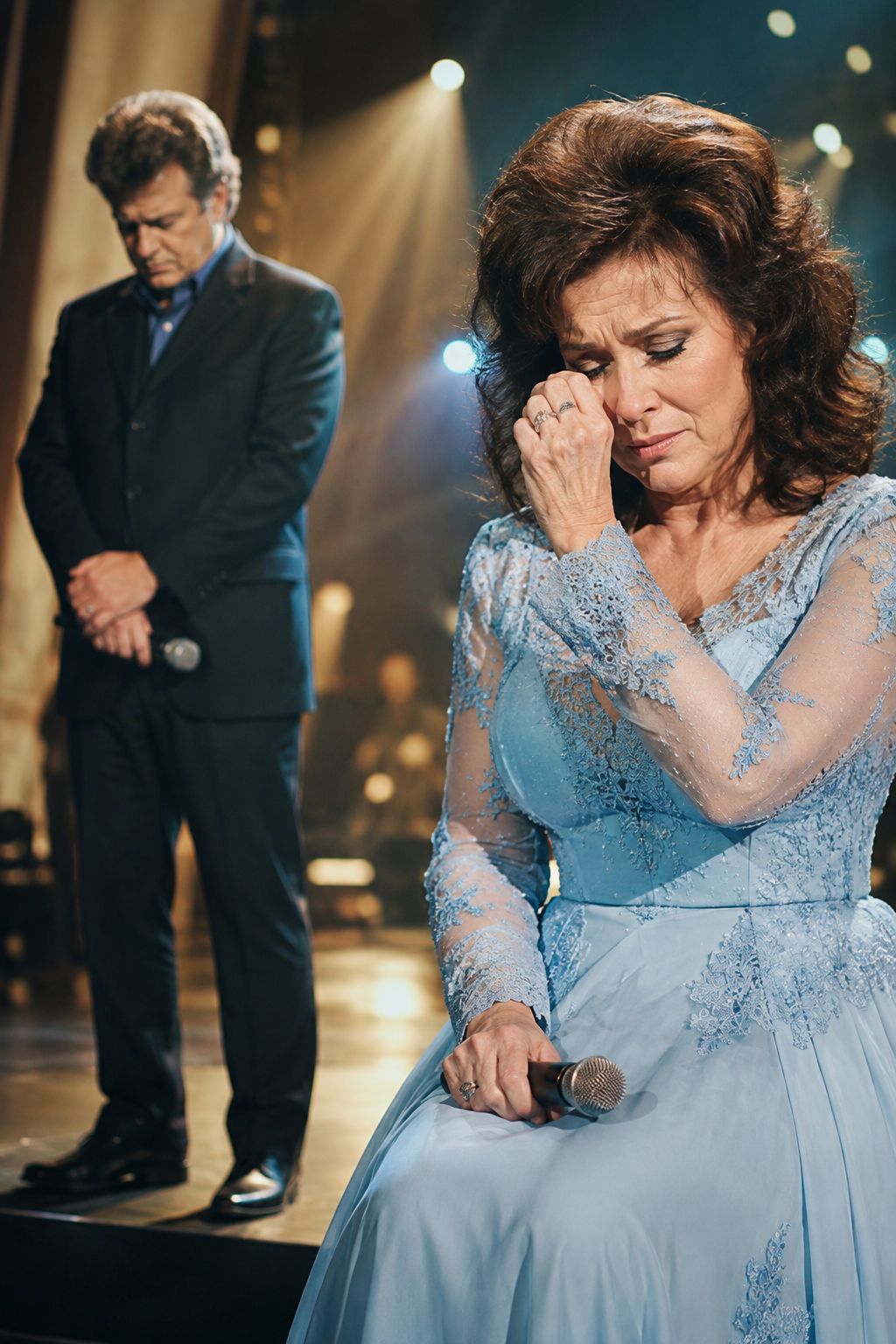
There are some goodbyes that happen with a final word.
Others happen with a final note.
For Loretta Lynn, one of the most painful musical goodbyes of her life came when the voice that had once answered hers across countless stages suddenly went silent forever.
Conway Twitty was gone.
And with him went something that could never be completely replaced: the unmistakable sound of Loretta Lynn and Conway Twitty singing together.
Their voices had spent years chasing, challenging, teasing, and complementing one another. One would begin a line, the other would answer. One would rise emotionally, the other would pull the song back down to earth. Together, they created a musical conversation that felt so natural that millions of listeners sometimes forgot they were watching two separate artists.
They were listening to a partnership.
And then, in 1993, that partnership was permanently silenced.
A DUET THAT NEVER SOUNDED LIKE ANY OTHER
When Loretta Lynn and Conway Twitty began recording together in 1971, neither could have known how deeply their partnership would become woven into the history of country music.
Their first major duet, “After the Fire Is Gone,” became a No. 1 country hit and earned them a Grammy. From there came songs that would become permanent fixtures of country music: “Lead Me On,” “Louisiana Woman, Mississippi Man,” “As Soon as I Hang Up the Phone,” and “Feelins’.” The Country Music Hall of Fame notes that Lynn and Twitty were named CMA Vocal Duo of the Year four consecutive years, from 1972 through 1975.
Their success was extraordinary.
But the statistics only tell part of the story.
The real magic was in the sound.
Loretta had that unmistakable Kentucky-born voice — powerful, direct, emotional, and sometimes almost conversational. Conway possessed a smoother, darker delivery, one that could make a simple country lyric feel like a confession whispered in the middle of the night.
Put them together, and something happened.
They sounded like two people who knew exactly where the other voice was going.
“The magic wasn’t simply that Loretta and Conway could sing. It was that they knew how to listen to each other.”
That chemistry became one of the defining sounds of classic country.
And fans noticed.
Some even assumed there had to be something romantic behind their performances because their songs could sound so intimate.
But Loretta herself rejected that interpretation. In an interview preserved by PBS, she explained that she loved Conway as a friend and emphasized that there was no romantic relationship between them.
That may have made their musical connection even more remarkable.
They didn’t need romance to create believable emotion.
They needed trust.
THE YEARS WHEN CONWAY AND LORETTA SEEMED UNSTOPPABLE
For much of the 1970s, it was difficult to imagine country music without the pair.
Their five consecutive No. 1 country singles established them as one of the most successful male-female partnerships of the era. Their recordings continued to arrive year after year, and they accumulated numerous awards and chart successes.
They weren’t simply recording occasional novelty duets.
They built an entire musical identity together.
Their songs were filled with jealousy, temptation, heartbreak, reconciliation, stubbornness, and longing — all the emotional territory that country music has always understood better than almost any other genre.
And somehow, even when the lyrics were complicated, their performances rarely sounded complicated.
Loretta and Conway made it feel effortless.
That is one of the great illusions of music.
The audience hears three minutes.
The artists have spent years learning how to make those three minutes feel inevitable.
THEN CAME THE CALL NO ONE EXPECTED
On June 5, 1993, Conway Twitty died suddenly after suffering a stomach aneurysm while traveling from a show in Branson, Missouri, toward Nashville for Fan Fair. The Country Music Hall of Fame records his death at age 59.
It was shockingly sudden.
Conway had spent his career on the road. His official biography emphasizes just how relentlessly he worked: in 36 years of touring, he reportedly never missed a show.
That makes his death feel even more unreal.
A man whose life seemed built around the next performance suddenly had no next performance.
No next recording.
No next tour.
No next duet.
And for Loretta, there was something uniquely painful about that finality.
Because there was no way to simply wait for Conway to return.
There would be no reunion tour.
No surprise appearance.
No new Conway & Loretta album.
No moment backstage when someone could say, “Let’s do one more.”
The possibility had disappeared forever.
THE LAST CHORD WASN’T REALLY A SONG
It is tempting to imagine a single cinematic moment when Loretta realized she would never sing with Conway again.
But history does not give us a verified scene in which she literally stopped after a performance, heard a final chord, and said those exact words.
The deeper truth is more heartbreaking.
The realization would have unfolded through absence.
A missing voice.
An empty space.
A song that suddenly sounded different.
A familiar harmony that could no longer be recreated in real time.
That is what death does to music.
It doesn’t erase the recordings.
It changes the way you hear them.
“The song remains exactly the same. The person listening to it is the one who has changed.”
For Loretta, Conway’s voice could still come through speakers.
It could still fill an arena.
It could still answer her on an old recording.
But it could never answer her again in the present.
That distinction is devastating.
WHY THEIR DUETS BECAME SO PERSONAL TO FANS
The remarkable thing about Conway Twitty and Loretta Lynn was how easily their songs became part of people’s own lives.
A couple could hear “After the Fire Is Gone” and remember a difficult chapter in their marriage.
Someone else could hear “Louisiana Woman, Mississippi Man” and remember a dance floor, a road trip, a jukebox, or a Saturday night from decades earlier.
Country music has always been good at preserving memories.
But duets have a special power.
Two voices can represent two people.
Two perspectives.
Two halves of a story.
And when one of those voices disappears, the surviving recording suddenly becomes something more than entertainment.
It becomes an artifact.
A little piece of time that cannot happen again.
LORETTA DIDN’T LOSE JUST A DUET PARTNER
Calling Conway merely Loretta’s “duet partner” doesn’t fully capture what he represented.
He was part of one of the most important creative chapters of her career.
Together, they won a Grammy for “After the Fire Is Gone” and four consecutive CMA Vocal Duo of the Year awards. Their partnership produced a remarkable catalog that remains central to the story of classic country music.
But beyond awards and chart positions was friendship.
Loretta’s own recollections make that especially important.
She didn’t describe Conway as simply another superstar she worked with.
She described him as a friend.
And when a friend dies unexpectedly, the loss doesn’t end when the funeral is over.
It follows you into ordinary moments.
A song on the radio.
An old photograph.
A familiar melody.
A name someone mentions.
A memory that arrives without warning.
For Loretta, every one of those things could bring Conway back for a few minutes.
Then the recording would end.
And reality would return.
THE STRANGE BEAUTY OF A RECORDED VOICE
There is something almost haunting about old country recordings.
The singers may be gone.
The studios may have changed.
The clothes may look dated.
The microphones may be antiques.
But press play, and suddenly the past speaks.
Conway is still there.
Loretta is still there.
They are still trading lines.
Still teasing each other.
Still building tension.
Still reaching that final note together.
And that is why the tragedy of their separation is also the beauty of their legacy.
Death could end the partnership in life.
It could not erase it from the record.
Their voices remain permanently connected.
LORETTA’S FINAL GIFT TO CONWAY
Perhaps the most meaningful way to understand Loretta’s loss is not to imagine her permanently trapped in grief.
Loretta Lynn continued to sing, record, perform, and build her own extraordinary legacy long after Conway’s death. She remained one of country music’s defining voices until her own passing in 2022.
That matters.
Because remembering someone doesn’t mean refusing to move forward.
Sometimes it means carrying their memory into everything that comes next.
Loretta couldn’t sing a new duet with Conway.
But she could keep singing the songs they had created together.
She could let audiences remember.
She could allow a new generation to hear that unmistakable harmony.
And every time the recording played, Conway’s voice could once again meet hers.
For three minutes, the years disappeared.
The loss disappeared.
The distance disappeared.
They were simply Conway and Loretta again.
THE FINAL CHORD THAT NEVER REALLY ENDED
Conway Twitty died in 1993.
Loretta Lynn died nearly three decades later, in 2022.
But their musical partnership never received a final goodbye in the way ordinary partnerships do.
There was no last planned duet designed to close the book.
No final concert announcement saying, “This is the last time.”
Life simply moved forward until suddenly it couldn’t.
And perhaps that’s why their recordings remain so powerful.
Because the listener knows something the singers didn’t know when those microphones were turned on:
That moment would never come back.
The laughter, the tension, the harmony, the answer from one voice to another — it was happening only once.
And then it became history.
“Some voices are remembered because they were beautiful. Others are remembered because they became part of who we were.”
Conway Twitty and Loretta Lynn belonged to the second category.
Their voices became part of weddings, broken hearts, long drives, old radios, family memories, honky-tonks, living rooms, and generations of country music lovers.
And when Conway died, Loretta lost something that no award could replace and no recording could fully restore.
She lost the possibility of hearing him answer her again.
But country music received a gift in exchange:
A body of songs in which the two could remain together forever.
The final chord may have been played decades ago.
But when “After the Fire Is Gone” begins again, something extraordinary happens.
Conway sings.
Loretta answers.
And for a few precious minutes, they are together once more.
That is the strange mercy of music: sometimes the people we lose never stop singing.
VIDEO: