 By admin
INTRODUCTION:
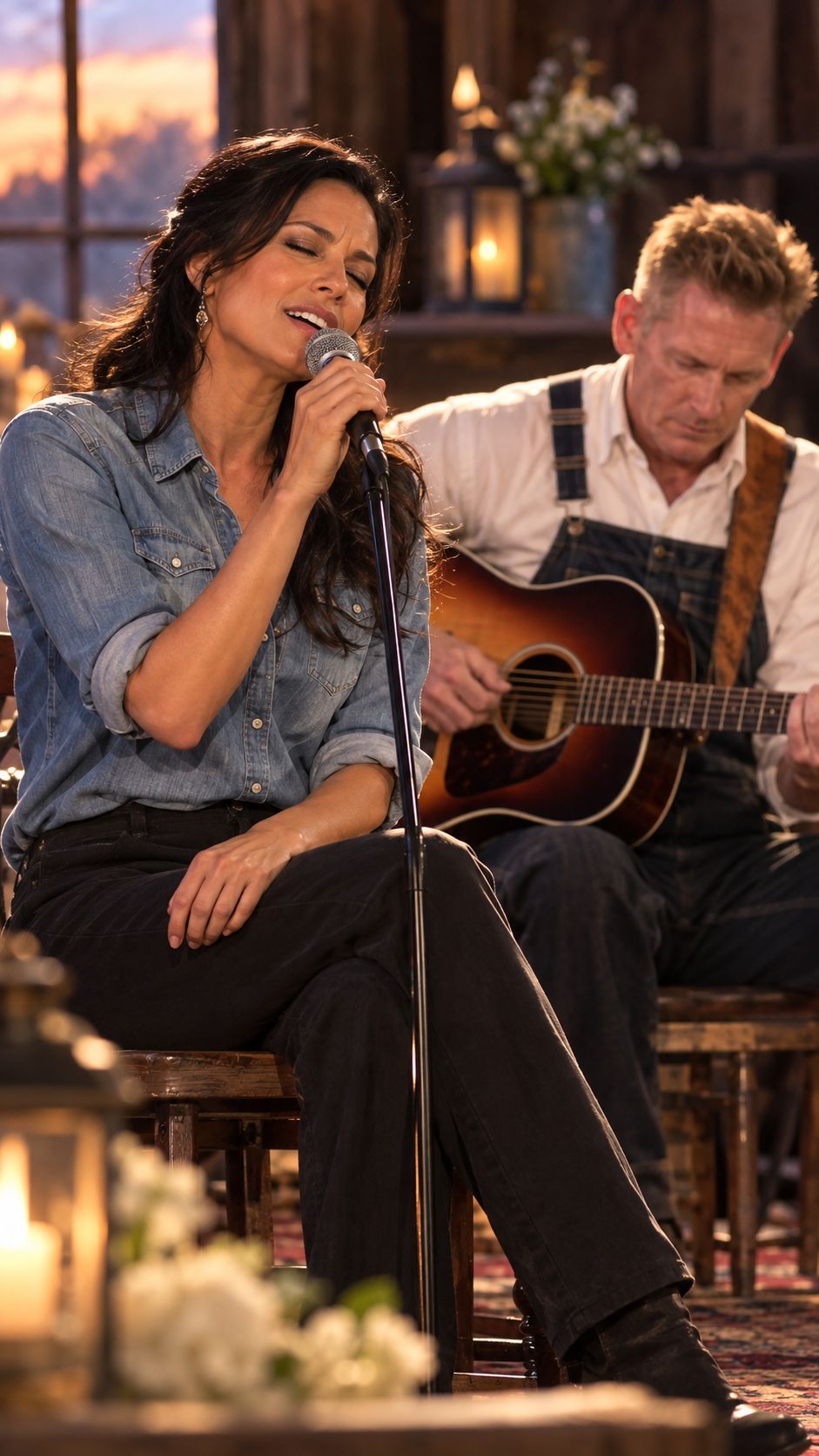
There are songs that entertain us, songs that remind us of someone we once loved, and songs that seem to reach into the deepest corners of our hearts. And then there are songs that become almost impossible to hear the same way again after life reveals a meaning we never expected. For countless country music fans, Joey Feek and the deeply emotional song When I’m Gone represent that extraordinary kind of musical experience.
Before the world came to know the devastating details of Joey’s battle with cervical cancer, her voice carried a tenderness that made even the simplest lyrics feel personal. As one half of the beloved country duo Joey + Rory, she built a connection with listeners through sincerity, faith, family, and an unmistakable country sound. She never needed elaborate performances or extravagant gestures to communicate emotion. Her voice could make a quiet melody feel like a conversation between two people who understood that life was precious.
After her cancer diagnosis and the heartbreaking final chapter of her life, songs associated with separation, love, and the possibility of saying goodbye began to resonate differently with many listeners. What once sounded like a moving musical reflection could now feel painfully close to reality.
But the story deserves more than a dramatic headline. It invites us to consider the power of music, the danger of hindsight, and the extraordinary way a singer’s voice can continue comforting people long after her final performance.
THE SONG THAT SEEMED TO FORESEE A FUTURE NO ONE COULD HAVE IMAGINED
In 2012, several years before Joey Feek received her devastating cancer diagnosis, she and her husband, Rory Feek, recorded a song that would eventually become one of the most emotionally significant recordings of their lives together.
The song was When I’m Gone, written by their friend Sandy Lawrence. Its central idea was both simple and heartbreaking: a loved one preparing to leave this world reassures the person left behind that, despite the grief, life will eventually continue.
At the time, Joey + Rory approached the song as artists who recognized its emotional power. They understood that it could help people struggling with the loss of someone they loved. They had no way of knowing that, just a few years later, its message would become intimately connected to their own family.
The song’s original purpose matters because its emotional power did not begin with Joey’s illness. It began with another woman’s grief, a songwriter’s attempt to process impending loss, and a melody that offered comfort when ordinary words seemed insufficient.
That is what makes the story so compelling. The song was not written as a prediction of Joey’s fate, and there is no evidence that she knew what awaited her. Instead, the tragedy lies in how a work of art created long before a personal catastrophe can acquire a new and deeply personal meaning afterward.
1. A Song Written From the Heart of Someone Else’s Grief
To understand the extraordinary emotional weight of When I’m Gone, it is important to return to the person who first gave the song its meaning.
Sandy Lawrence, a friend of Joey Feek, wrote the song while watching her own mother approach the end of her life. She was facing a reality that millions of people eventually encounter: the possibility of losing a parent and the desperate desire to hear that everything will somehow be all right afterward.
Grief can be difficult to articulate. People often struggle to find the right words when someone they love is dying. They want reassurance, permission to continue living, and some indication that moving forward will not mean abandoning the person they have lost.
Lawrence transformed those emotions into a song.
Rather than concentrating exclusively on death, the composition considers what happens afterward. The world continues to turn. Morning arrives. Familiar places remain familiar, even when the person who once shared them is no longer there.
That perspective gives the song its unusual emotional balance. It acknowledges the pain of separation without suggesting that a person must remain trapped in sorrow forever.
When Joey + Rory encountered the song, they recognized something special in its message. Joey was particularly affected by the idea of a person preparing a loved one for life after their departure.
For a country singer whose greatest strength was emotional sincerity, the material offered an opportunity to communicate something more intimate than conventional heartbreak.
It was a song about love facing its most difficult test: learning to imagine a future in which the person who made life feel complete would no longer be physically present.
And that was a message Joey could convey with remarkable tenderness.
2. The 2012 Music Video That Became Almost Unbearable to Watch
The story became even more poignant when Joey + Rory created a music video for the song in May 2012.
The setting was their Tennessee farmhouse, a place associated with family, home, and the quiet routines that shaped their lives outside the music industry.
The creative decision that changed everything was the suggestion that Joey sing the song directly to Rory, imagining that she was the one who would die first.
Rory Feek initially resisted the idea.
The concept felt too personal. It asked him to imagine losing his wife and facing a future in which the home they shared would remain while she would no longer be there.
Yet he eventually recognized that this was precisely what the song required. Rather than hiding behind a performance, the couple allowed themselves to consider the situation the lyrics described.
The result was a video that carried a remarkable sense of intimacy.
There were no elaborate special effects or extravagant visual distractions. The emotional center was the relationship between two people who loved each other and were willing to explore a painful hypothetical possibility for the sake of the song.
In retrospect, that decision is almost overwhelming.
Viewers watching the video after Joey’s death knew something that neither performer could have known with certainty in 2012: the imagined separation would become their actual reality.
The farmhouse, the surrounding land, and the couple’s expressions took on a different significance.
What had originally been an artistic exercise in empathy became a lasting document of their love.
But the distinction between art and prophecy remains important. The video did not foretell the future in any demonstrable sense. Its power comes from the painful coincidence between the story it portrayed and the events that followed.
Sometimes, the most haunting things in life are not supernatural mysteries. They are ordinary moments whose significance becomes clear only after everything has changed.
3. When Cancer Changed the Meaning of Every Word
In June 2015, Joey Feek was diagnosed with stage IV cervical cancer. The diagnosis began a devastating chapter for the family.
Treatment followed, but the disease ultimately progressed. By late 2015, the couple was confronting the reality that Joey’s illness was terminal.
Suddenly, When I’m Gone was no longer simply a song about someone else’s experience of loss.
Its central question had become painfully personal: How does a person prepare the people they love for a life that must continue without them?
For Rory, the song’s meaning was transformed. The possibility they had once explored on camera was now unfolding in their own lives.
The couple’s circumstances gave the recording a depth that no artistic technique could manufacture. Every familiar detail of their shared life became more precious as the future they had imagined together grew increasingly uncertain.
For Joey, the song offered a way to communicate emotions that were difficult to express through ordinary conversation. For Rory, it became a means of hearing her voice and revisiting the reassurance contained in the music.
Their experience also demonstrated something fundamental about the role of art during serious illness.
Music cannot reverse a diagnosis. It cannot guarantee a cure or eliminate the pain of saying goodbye. Yet it can give people a language for experiences that otherwise seem impossible to explain.
A song can hold fear and hope at the same time. It can acknowledge that a loss is coming without allowing that loss to erase everything meaningful that came before it.
That is part of the reason When I’m Gone continues to affect listeners so deeply.
It does not offer a simplistic promise that grief will disappear. Instead, it recognizes that love and sorrow can coexist, and that the process of learning to live after a devastating loss does not diminish the relationship that came before.
4. Why Rory Feek Saw the Recording as a Gift
As Joey’s condition deteriorated, Rory Feek reflected publicly on the song and its unexpected relevance to their circumstances.
His perspective was profoundly different from what it had been during the original recording.
In 2012, he had struggled with the idea of imagining a life without his wife. During her final illness, he was living through the reality he had once found so difficult to contemplate.
Yet he did not view the recording only as a cruel reminder of what was happening.
Instead, Rory came to regard it as a gift: a way of hearing Joey’s voice, remembering her love, and receiving a message of reassurance even when their circumstances made ordinary conversations increasingly difficult.
That interpretation reveals an important aspect of their relationship.
Joey + Rory were not simply musical partners who happened to be married. Their shared work was inseparable from the life they had built together. Their songs reflected their values, their faith, their family, and their understanding of what mattered most.
When Joey could no longer be present in the same way, the recordings became a form of continuity.
They preserved the sound of her voice, the emotion in her delivery, and the connection she had shared with Rory.
The recording could not replace the person he was losing. But it could remain a tangible reminder of the person he had loved.
There is something profoundly human in that distinction.
We often hold on to photographs, letters, familiar objects, and recordings after someone dies. These things do not bring the person back, but they allow memories to remain connected to something we can see, hear, or touch.
For Rory, When I’m Gone became one of those lasting connections.
The song’s importance was no longer measured only by its musical qualities. It was measured by what it meant to the man who had to learn how to live without the woman singing it.
5. The Album That Gave the Song a New Place in Their Story
The song’s significance grew further when When I’m Gone appeared on Hymns That Are Important to Us, the 2016 album by Joey + Rory.
Although the composition was not a traditional hymn, its message of love, loss, and reassurance made it especially meaningful during Joey’s final months.
The album itself carried enormous emotional weight. Joey was determined to continue working on music despite the physical difficulties associated with her illness. Rory later described the project as the last record they would make together.
That context changed how listeners encountered the song.
A recording originally made in 2012 had become part of a final musical chapter that the couple could not have imagined when they first performed it.
The album represented more than a collection of songs. It preserved a period in which music, faith, marriage, and family converged under extraordinary circumstances.
Joey’s determination to sing, even as her strength declined, also demonstrated how deeply music remained connected to her identity.
She was not simply a person facing a terminal diagnosis. She was a singer who continued to value the act of sharing songs with other people.
That distinction matters.
It would be easy to remember Joey exclusively through the tragedy of her illness. But doing so would overlook the musician, wife, mother, and artist whose life contained far more than its final chapter.
Hymns That Are Important to Us helped preserve that broader picture. It captured her voice during a period when the opportunity to create new recordings together was becoming painfully limited.
In that context, When I’m Gone became a bridge between the couple’s earlier years and the farewell that followed.
It connected the joy of making music together with the difficult work of accepting that their time together was limited.
6. The Song’s Deeper Message: Grief Does Not Cancel Love
Perhaps the most important reason When I’m Gone continues to resonate is that its message extends far beyond the story of Joey + Rory.
The song addresses a universal fear: that losing someone we love will make ordinary life impossible.
People who experience bereavement often describe the strange disorientation of returning to familiar routines. The kitchen still looks the same. The sun rises at its usual hour. The world continues moving even though an essential part of one’s personal world has disappeared.
That contrast can feel unbearable.
The song recognizes this emotional reality while gently suggesting that survival does not require forgetting.
Moving forward does not mean that a relationship was unimportant. Finding moments of happiness again does not mean that grief has vanished. And learning to live with an absence does not mean that love has ended.
For many listeners, this is the most comforting part of the song’s message.
It offers the possibility that grief can gradually change shape. The sharpness of the earliest pain may soften, and memories that once seemed unbearable may eventually bring comfort as well as sadness.
That is not a promise that everyone grieves in the same way or follows a predictable timeline. It is an acknowledgment that people can carry love forward even when the person they love is no longer physically present.
In Joey’s case, her recordings gave that idea a particularly powerful expression.
Her voice remained available to listeners long after her death. Her performances continued to communicate warmth, tenderness, and sincerity to people who had never met her.
For Rory, the recordings preserved a personal connection. For fans, they offered a way to remember an artist whose work had become intertwined with an extraordinary family story.
The music did not erase the loss. It gave the loss a place within a larger story of love.
7. Why Fans Still Find the Story So Haunting
Joey Feek died on March 4, 2016, at the age of 40. Her death brought an end to a life and career that had touched many country music listeners.
Yet the story of When I’m Gone continues to attract attention because it brings together several powerful elements: an emotionally direct song, a loving marriage, an unexpected medical tragedy, and a recording that acquired a new meaning after the fact.
The story also challenges the way people think about songs and their relationship to real life.
When listeners hear a familiar recording, they often associate it with the period in which they first discovered it. But music can change as our own experiences change.
A song about heartbreak may sound different after a divorce. A song about family may become more meaningful after becoming a parent. And a song about saying goodbye may become almost unbearable after losing someone close.
The recording itself remains the same. The listener does not.
That is what happened with When I’m Gone. Its meaning expanded as the circumstances surrounding Joey and Rory changed.
For longtime fans, listening to the song after Joey’s death means hearing two stories at once: the imagined farewell portrayed in the original music video and the real farewell that followed several years later.
The emotional effect is powerful precisely because the couple had not set out to create a memorial.
They had made a song they believed might help other people. Only later did they discover how deeply they would need its message themselves.
Their experience reminds us that a piece of music can become part of our lives in ways its creators never anticipated.
A song can begin as a friend’s attempt to process grief, become a recording by a husband and wife, and eventually serve as a source of comfort for countless strangers.
Its meaning grows because people bring their own experiences to it.
And sometimes, the most enduring songs are those that help us confront the feelings we would rather avoid.
8. The Legacy of Joey Feek: Remembering More Than Her Final Days
It is tempting to define Joey Feek by the tragedy surrounding her final months. Her courage during treatment, her commitment to her family, and the public attention surrounding her illness understandably remain important parts of her story.
But her legacy deserves to be understood more broadly.
Before the diagnosis, Joey was already an accomplished country singer whose warmth and sincerity helped distinguish Joey + Rory. Alongside Rory Feek, she created music rooted in traditional country storytelling, close harmonies, faith, and the everyday experiences of ordinary people.
Their appeal was never solely about technical perfection or commercial success. It was about authenticity.
Listeners could hear a relationship reflected in their performances. Their music often felt personal without becoming inaccessible, emotional without becoming theatrical, and traditional without losing its ability to connect with new generations.
When I’m Gone brought those qualities into especially sharp focus.
The song asked listeners to consider one of life’s hardest possibilities while offering reassurance that love could survive a profound change in circumstances.
Joey’s later illness made that message more painful, but it did not create the song’s underlying truth.
That truth existed from the beginning, in the experience of Sandy Lawrence and the grief that inspired her writing.
Joey gave the composition her voice. Rory helped preserve its meaning. And listeners continued to find their own experiences reflected in it.
Her legacy, therefore, is not simply a story about a singer who died too young.
It is also a story about an artist whose work helped people face difficult emotions, a couple who shared their lives through music, and a recording that became a lasting reminder of the importance of telling the people we love what they mean to us.
That is a legacy worth remembering beyond the headlines.
CONCLUSION: A SONG THAT BECAME A LASTING GOODBYE
The story of Joey + Rory’s When I’m Gone is heartbreaking because its emotional center changed so dramatically over time.
In 2012, the couple recorded a song that they hoped would comfort people facing loss. They made a video imagining a future in which Joey was gone and Rory had to continue living without her.
Years later, after Joey’s terminal cancer diagnosis, that imagined future became a painful reality.
No one can know precisely why certain songs arrive in our lives when they do, or why their meanings sometimes seem to grow far beyond their original intentions. But the story of this recording illustrates how music can preserve something precious when circumstances take away the possibility of making new memories together.
Joey Feek died in 2016, but her voice remains part of the musical legacy she created with Rory Feek. The song they recorded together continues to remind listeners that grief is not evidence of love’s failure, and that continuing to live does not mean leaving someone behind.
Perhaps that is the most important lesson in this remarkable story.
A farewell does not erase a shared life. A recording cannot replace a person, but it can preserve a voice, a feeling, and a moment that might otherwise exist only in memory.
And sometimes, the song that hurts the most is also the one that helps us find the words to keep going.
When I’m Gone was never merely a song about death. It was a song about the love that remains when someone is no longer there to express it in person.
For Joey and Rory, that message became painfully personal.
For the people who continue to listen, it remains a reminder to cherish the time we have, to speak honestly about love, and to recognize that the most meaningful songs are often those that help us understand what it means to be human
VIDEO: