 By admin
 INTRODUCTION:
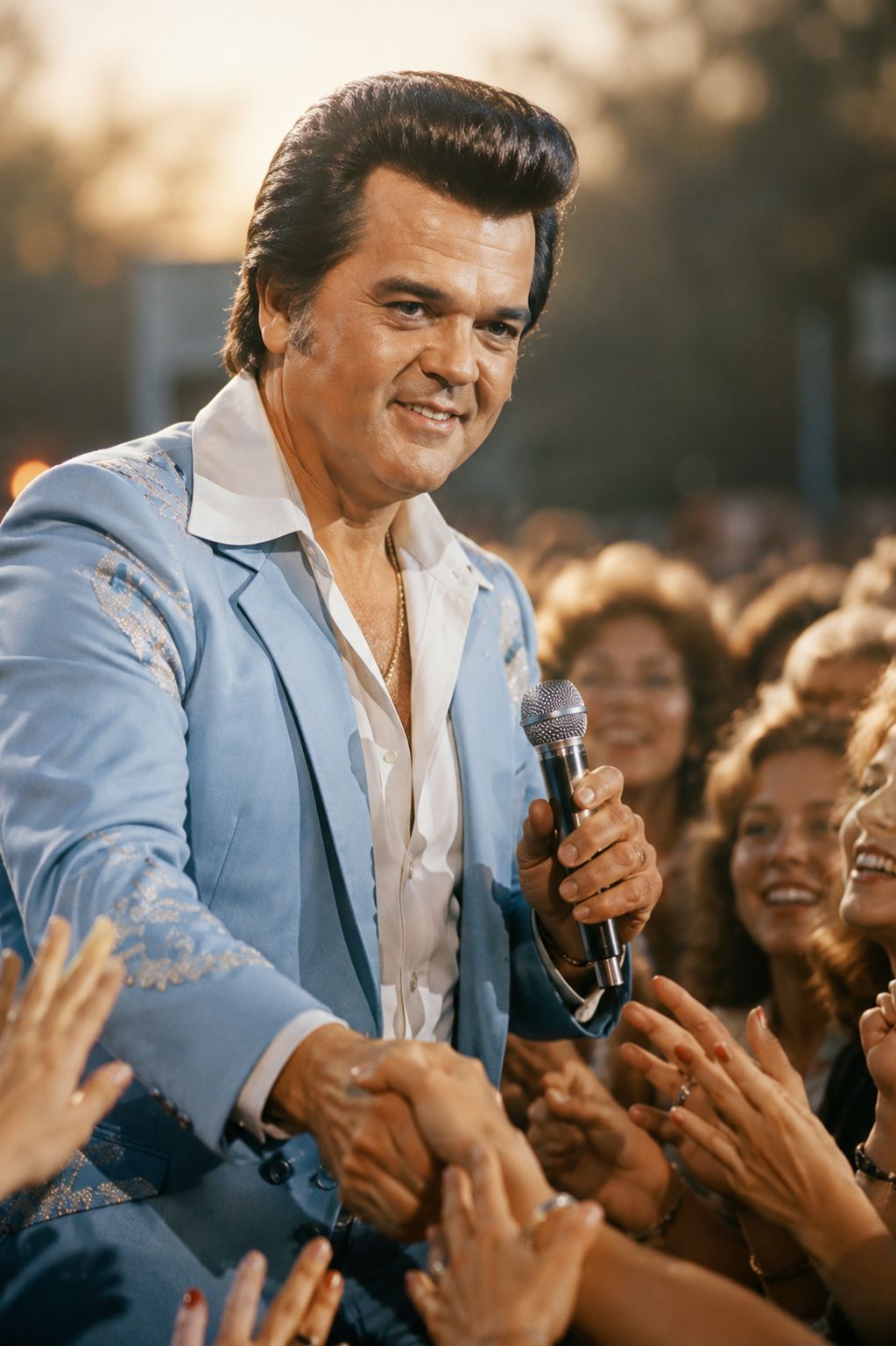
There are singers whose voices become famous.
And then there are singers whose voices become memories.
For millions of country music fans, especially the women who grew up with heartbreak ballads playing on the radio, Conway Twitty was more than a singer. He was the voice that seemed to understand the words they could never say out loud—the voice that could turn loneliness into longing, regret into romance, and a few simple sentences into something deeply personal.
But the fascinating story of Conway Twitty begins long before the slick hair, tailored suits, sold-out country concerts, and legions of devoted female fans.
It begins with a young man named Harold Lloyd Jenkins, a Mississippi-born musician who once dreamed of baseball, briefly conquered rock ’n’ roll, and eventually reinvented himself as one of the most influential voices in country music history.
And strangely enough, much of the mystery surrounding his appeal can be traced to just two words:
“Hello, darlin’.”
Those two words were enough to make an entire audience lean forward.
Before Conway, There Was Harold
Born on September 1, 1933, Conway Twitty grew up in the American South, surrounded by music and the culture that would eventually shape his career. He learned guitar from his grandfather and a neighborhood blues singer and was already performing on radio as a child.
Baseball was another passion. He was talented enough to attract attention from the Philadelphia Phillies, but military service interrupted that dream.
Then came rock ’n’ roll.
After hearing Elvis Presley, the young Jenkins headed toward Memphis and Sun Records. He eventually adopted the stage name Conway Twitty, combining the names of Conway, Arkansas, and Twitty, Texas.
In 1958, everything changed.
“It’s Only Make Believe” exploded onto the charts.
The song reached No. 1 and became an international sensation, selling millions of copies. Twitty’s voice was so reminiscent of Elvis that some listeners initially wondered whether they were hearing Presley under another name.
Suddenly, Conway Twitty was a teenage idol.
But there was a problem.
The man behind the famous voice didn’t necessarily want to remain there.
He Wasn’t Trying to Be Elvis
The comparisons with Elvis were unavoidable.
Twitty had the growl. He had the looks. He had the stage presence. He had the screaming fans.
But underneath the rock ’n’ roll image was something much more complicated.
Country music had always been close to his heart.
Twitty wanted to sing about real life—love, marriage, betrayal, regret, loneliness, temptation and the complicated emotions that people rarely admitted publicly.
Eventually, he made the risky decision to move toward country music.
At the time, people around him questioned the decision. Why would a successful rock star walk away from the money and excitement of rock ’n’ roll?
Twitty did it anyway.
And history proved him right.
After years of skepticism from country radio, he began building an entirely new career. His first country No. 1 came with “Next in Line,” beginning a remarkable run that eventually produced 40 No. 1 Billboard country hits, according to the Country Music Hall of Fame.
But the greatest transformation was not musical.
It was emotional.
The Moment Two Words Changed Everything
In 1970, Conway Twitty released a song that would become inseparable from his identity.
“Hello Darlin’.”
The song was written by Twitty himself. It tells the story of a man unexpectedly encountering an old love. At first, he tries to appear confident—as though his life has moved on.
But then the mask begins to crack.
He admits he cannot sleep.
He admits he still cries.
He admits that the woman standing in front of him still has power over his heart.
And then there was that opening.
“Hello, darlin’.”
Producer Owen Bradley reportedly suggested that Twitty speak the opening line rather than sing it.
That tiny decision became legendary.
Instead of beginning with a dramatic vocal flourish, Twitty sounded as though he had walked into the room, looked directly at one woman, and quietly spoken to her.
It felt private.
It felt intimate.
It felt real.
The song spent four weeks at No. 1 on the Billboard country chart and became Twitty’s signature song and traditional concert opener. It was later inducted into the Grammy Hall of Fame.
And perhaps most importantly, it demonstrated exactly why women connected so strongly with Conway Twitty.
He didn’t simply sing about heartbreak.
He sounded like a man who had lived it.
Why Women Heard Something Different in His Voice
Conway Twitty understood something many performers never fully learn:
A love song doesn’t have to shout to be powerful.
Sometimes a whisper is more devastating.
His voice carried a mixture of confidence and vulnerability. There was masculinity in the deep growl, but there was also insecurity, tenderness and desperation.
That combination became his secret weapon.
His songs frequently explored relationships that were messy rather than perfect. Infidelity, guilt, desire, regret and emotional conflict appeared repeatedly in his songwriting and recordings.
That was important.
Because real relationships are messy.
The woman listening to Conway Twitty wasn’t necessarily hearing a fantasy.
She was hearing a story that could remind her of a husband, an old boyfriend, a lost love—or perhaps a decision she still regretted decades later.
And Conway knew exactly how powerful that could be.
He once explained his approach to songs this way:
“I pick a song women will like.”
But the second half of that thought revealed even more about his artistry: he wanted songs that expressed the things men often felt but didn’t know how to say.
That was Conway Twitty’s great gift.
He gave men the words—and gave women the feelings.
The Voice Behind the Mystery
There was another reason Conway became so fascinating.
He rarely explained himself.
The Country Music Hall of Fame notes that Twitty maintained an unusually minimalist stage persona. For years, he avoided extensive onstage conversation, interviews, music-business parties and even encores. His concerts were built around the songs themselves.
That created mystery.
While other stars talked endlessly between songs, Conway let the music speak.
He understood that silence could create anticipation.
When he finally sang, the audience listened.
His concerts became famous for their fervent female crowds, so much so that comedian and country personality Jerry Clower nicknamed him “The High Priest of Country Music.”
It was an extraordinary phenomenon.
The man didn’t need to tell the audience what to feel.
They already knew.
And Then Came Loretta Lynn
If Conway Twitty’s solo career revealed the lonely side of romance, his partnership with Loretta Lynn revealed another dimension.
Together, they created one of country music’s most celebrated male-female partnerships.
Their recordings included “After the Fire Is Gone,” “Louisiana Woman, Mississippi Man” and “Feelin’s.” They earned a Grammy and four CMA Awards for their collaborative work.
Their chemistry was undeniable.
But it was also carefully constructed artistry.
Onstage, Conway could look at Loretta and make a lyric feel like a private conversation.
Their performances blurred the line between acting and singing.
Were they characters?
Were they lovers?
Were they simply two brilliant performers?
The audience didn’t necessarily need to know.
They only needed to believe.
And for a few minutes, they did.
The Man Who Turned Heartbreak Into a Career
Conway’s success continued through the 1970s and 1980s.
Songs such as “Fifteen Years Ago,” “Linda on My Mind,” “You’ve Never Been This Far Before,” “I’d Love to Lay You Down,” and “Tight Fittin’ Jeans” showed how dramatically his sound and image evolved.
He could be vulnerable.
He could be seductive.
He could be regretful.
He could be playful.
But there was almost always one thing underneath it all:
emotion.
And that may be the real explanation for why millions of women fell for his music.
It wasn’t simply his voice.
It wasn’t simply his appearance.
It wasn’t simply the romantic lyrics.
It was the illusion that, when Conway Twitty sang, he was singing directly to one person.
You.
The Tragedy of His Final Chapter
On June 5, 1993, Conway Twitty died at the age of 59 after suffering an abdominal aneurysm following a performance in Branson, Missouri.
He left behind one of the most extraordinary legacies in country music.
His career had lasted through enormous changes in American music—from the birth of rock ’n’ roll to the evolution of modern country.
He had been a rock star.
A teen idol.
A songwriter.
A country superstar.
A duet partner.
And, ultimately, a voice that became inseparable from romantic storytelling.
The Country Music Hall of Fame inducted him in 1999, recognizing a career that had produced more No. 1 records than any country artist had achieved at that time.
But statistics cannot fully explain Conway Twitty.
Charts cannot explain why a woman could hear the opening of “Hello Darlin’” decades later and suddenly remember exactly where she was when she first heard it.
Numbers cannot explain why his voice still sounds personal.
And awards cannot explain why a man who died more than three decades ago can still make a listener feel as though he is standing across the room, quietly telling her a secret.
The Two Words That Never Really Went Away
Maybe that is the true untold story of Conway Twitty.
He spent his career changing identities.
Harold Jenkins became Conway Twitty.
The rock ’n’ roll idol became a country legend.
The Elvis-influenced young singer became one of Nashville’s most distinctive voices.
And the man who once chased the sound of rock ’n’ roll eventually discovered that his greatest power was not in making people dance.
It was in making them feel.
So when those two words come through the speakers—
“Hello, darlin’…”
—it isn’t just an introduction.
It is a doorway.
A doorway back to another time.
Back to old radios, slow dances, handwritten love letters, empty highways and memories of people who may no longer be there.
That is why Conway Twitty remains unforgettable.
Because he didn’t just sing about love.
He made listeners remember what love once felt like.
And perhaps that is why, decades after his final performance, millions of women still hear that unmistakable voice—and for just a moment, they fall in love all over again.
VIDEO: