 By admin
INTRODUCTION:
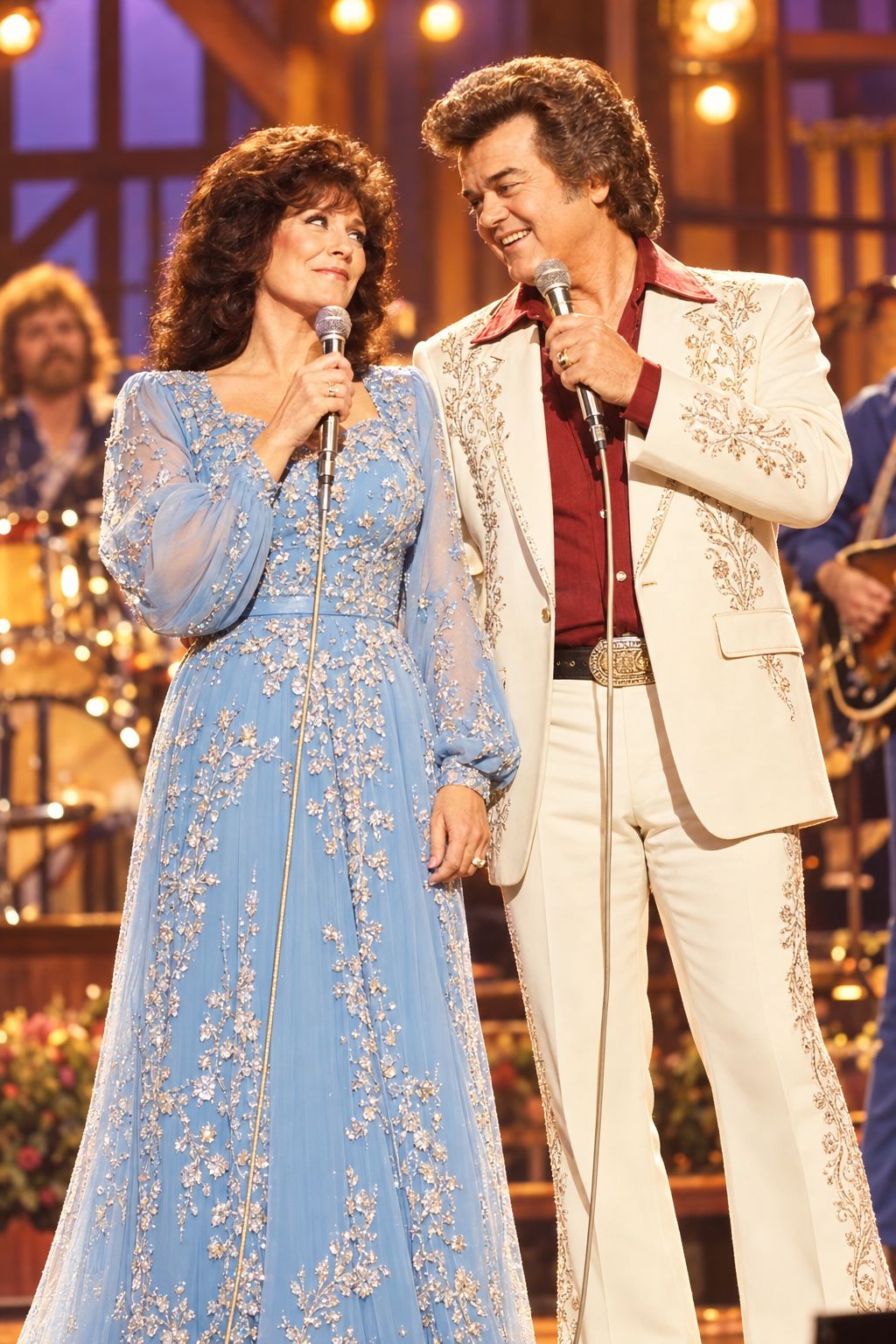
There are country duets that sound good.
And then there are Conway Twitty and Loretta Lynn.
When their voices met, something almost unsettling happened. It didn’t sound like two famous singers standing behind microphones. It sounded like two people who knew each other’s secrets.
A teasing glance. A pause between lines. Loretta’s fiery delivery answering Conway’s smooth baritone. One moment they sounded affectionate; the next, jealous, wounded, or dangerously close to crossing a line.
For decades, fans asked the question that refuses to disappear:
Were Conway Twitty and Loretta Lynn secretly in love?
The answer is both less scandalous—and arguably more fascinating—than the legend.
Because the available evidence points not to a hidden affair, but to an extraordinary professional friendship so convincing that millions of listeners couldn’t separate the performers from the characters they created. Loretta herself directly addressed the rumors, saying people thought she and Conway “had a thing,” but that this was “the farthest from the truth.”
And yet, once you listen to their records again, you can understand exactly why nobody believed it.
The First Spark Was Musical, Not Romantic
The story began before their legendary recording partnership.
Lynn and Twitty first sang together for fun in 1969 while touring Europe as part of a country music package. Contemporary material preserved by the University of Nevada, Las Vegas, records Twitty describing Lynn as a longtime fan of his music—and himself as a fan of hers.
That mutual admiration became the foundation for something much bigger.
In 1971, they released “After the Fire Is Gone.”
The song was practically designed to create controversy.
Its story centers on two people whose relationship has lost its passion and who become tempted by someone outside their marriages. The subject matter was provocative, but the real danger was how convincingly Lynn and Twitty performed it. Their voices didn’t sound like actors reading lyrics.
They sounded like people confessing.
The song became their first No. 1 hit together and launched one of the most successful male-female partnerships in country music.
And that’s when the rumors really began.
“Maybe they aren’t acting.”
That thought became the invisible third voice in every duet.
The “Secret” Was Hiding in Plain Sight
Here’s where the story becomes fascinating.
Conway and Loretta didn’t need a real romance to create romantic tension.
They were professionals telling stories.
Their greatest songs frequently dealt with complicated relationships: temptation, regret, marriage, jealousy, separation, forbidden desire and reconciliation. Instead of singing those subjects from a safe emotional distance, they inhabited them.
That’s why their performances could feel almost voyeuristic.
It was as if the audience had accidentally walked into someone’s living room during an argument.
“Louisiana Woman, Mississippi Man” was playful and flirtatious. “Lead Me On” carried a different emotional weight. “Feelins’” explored vulnerability. And “After the Fire Is Gone” practically invited listeners to imagine a secret relationship.
Their voices were perfectly matched for this kind of storytelling.
Twitty’s controlled, velvet-like baritone could sound confident even when the lyrics suggested vulnerability.
Lynn’s voice could turn a single phrase into an accusation.
Together, they created tension.
And tension is what makes great storytelling unforgettable.
The Rumors Became So Serious That They Had Real Consequences
This wasn’t merely harmless fan gossip.
The rumors followed them into real life.
According to archival material held by UNLV, speculation about a romantic relationship between Lynn and Twitty persisted despite both being married to other people. After Twitty’s marriage broke up in 1973, an angry fan even blamed Lynn and threatened violence at one of her concerts. The venue was evacuated and searched before the show continued.
Imagine that for a moment.
Two performers create believable fictional chemistry onstage—and suddenly people outside the music begin treating the fiction as fact.
That’s the strange power of country music.
Country songs are built around emotional truth. But emotional truth isn’t necessarily biographical truth.
A singer can perform heartbreak without being heartbroken.
An actor can portray desire without being in love.
And two musicians can sound like lovers without ever becoming lovers.
Conway and Loretta were simply extraordinarily good at making listeners believe.
Loretta Lynn Eventually Gave the Clearest Answer
If there is one piece of evidence that should make sensational claims about a secret affair much harder to defend, it’s Loretta Lynn’s own explanation.
In the PBS American Masters material about their partnership, Lynn recalled that audiences assumed she and Conway had a romantic relationship.
Her answer was unequivocal.
She said she loved Conway as a friend, and added that her husband, Oliver “Doolittle” Lynn, also loved and respected him.
That detail is especially revealing.
Loretta wasn’t describing some forbidden relationship that had been hidden for decades.
She was describing trust.
And perhaps that is the part fans overlooked.
The Man Behind the Rumor Was a Friend
Conway’s own comments also point in the same direction.
Archival material records Twitty describing Lynn as one of his best friends in the music business and explicitly denying that anything romantic had happened between them.
That doesn’t mean their relationship wasn’t special.
It means we should define “special” differently.
They had something many artists never find: complete artistic trust.
They knew how the other singer would phrase a line.
They knew when to pull back.
They knew when to push harder.
They knew how much emotion was enough—and how much would be too much.
That kind of musical intimacy can look remarkably similar to romantic intimacy.
But it isn’t necessarily the same thing.
And Their Success Was Almost Unbelievable
The numbers tell their own story.
According to PBS, Lynn and Twitty recorded 11 studio albums together between 1971 and 1988, producing five No. 1 songs from five different albums. They also won the Country Music Association’s Vocal Duo of the Year award four consecutive times, from 1972 through 1975.
The Country Music Hall of Fame likewise identifies “After the Fire Is Gone” as the song that launched their legendary partnership and highlights hits including “Lead Me On,” “Louisiana Woman, Mississippi Man,” and “Feelins’.”
Conway’s official biography describes their partnership as one of the defining male-female collaborations in country music, noting that they became the most awarded male/female duet partnership in history.
That’s not the footprint of a secret affair.
That’s the footprint of a musical phenomenon.
Why Did Everyone Believe the Romance Anyway?
Because the songs were designed to make you believe.
Think about what happens when you hear a great duet.
The singers aren’t simply exchanging lyrics.
They’re exchanging emotional information.
One says, “I want you.”
The other says, “You can’t have me.”
One pulls closer.
The other pushes away.
Then, suddenly, they harmonize.
Your brain naturally interprets that musical conversation as a relationship.
Conway and Loretta understood that instinctively.
They didn’t destroy the illusion.
They protected it.
And perhaps that is the real secret.
They didn’t fool us because they were secretly lovers. They fooled us because they were extraordinary storytellers.
The Most Emotional Truth May Be the Simplest One
Loretta and Conway didn’t need a secret romance to create something intimate.
They needed friendship.
Respect.
Trust.
And the ability to walk into a recording studio and temporarily become somebody else.
That’s what makes their story so enduring.
They could sing about temptation without surrendering to it.
They could sing about forbidden love without living it.
They could sound like two people with years of emotional history—even when the real history was one of professional respect and friendship.
And perhaps that’s why their music still works.
Because the audience was never really supposed to know where the characters ended and Conway and Loretta began.
The Legacy Outlived the Rumors
Conway Twitty died in 1993, while Loretta Lynn died in 2022. But their musical partnership continues to echo through country music.
Even their families have carried the tradition forward. Loretta’s granddaughter Tayla Lynn and Conway’s grandson Tre Twitty formed Twitty & Lynn, performing their grandparents’ songs and keeping the musical legacy alive for a new generation.
That may be the strongest evidence of all.
The legacy didn’t survive because of a scandal.
It survived because the music was genuinely great.
Their voices still sound like they are arguing.
Still flirting.
Still forgiving.
Still breaking each other’s hearts.
And somewhere between the first note and the final harmony, we forget that we’re listening to two legendary performers.
We start believing we’re listening to two people revealing something private.
Maybe that was the greatest trick Conway Twitty and Loretta Lynn ever pulled.
They didn’t have to live the love story.
They only had to make us believe it.
And after more than half a century, we’re still listening.
The rumor may have been false—but the chemistry was absolutely real.
So now the question belongs to you:
Do you believe Conway Twitty and Loretta Lynn were simply two brilliant friends and performers—or do you think there was something deeper behind their unforgettable chemistry?
Tell us what you think. And name the Conway & Loretta duet that still gives you chills every time you hear it.
VIDEO: