 By admin
INTRODUCTION:
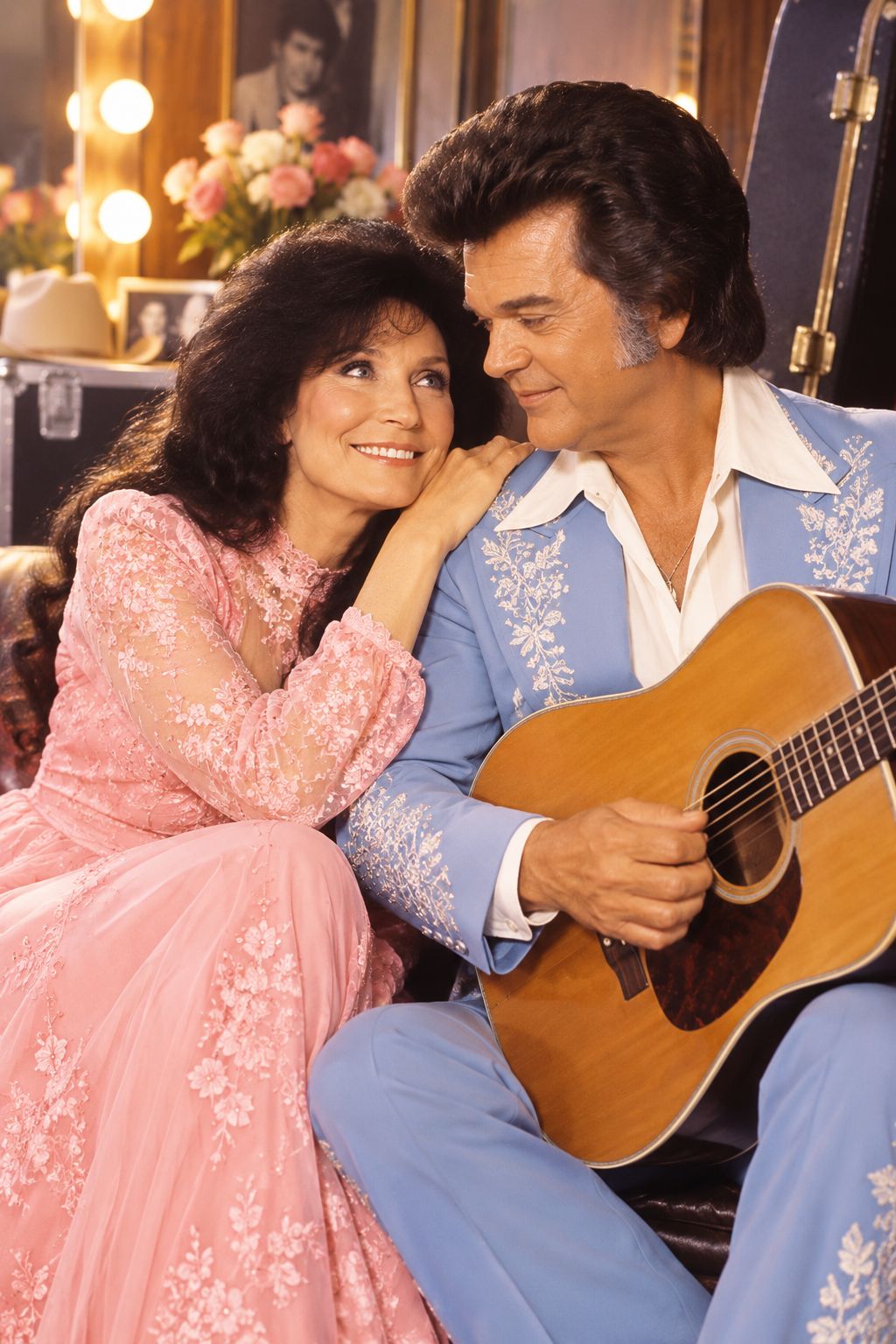
There are some country songs that sound like performances.
And then there are songs that sound like someone accidentally left a microphone running while two people confessed things they were never supposed to say out loud.
That was the strange magic of Conway Twitty and Loretta Lynn.
For more than a decade, their voices created the illusion of a relationship so believable that millions of listeners wondered whether the chemistry between them was more than music. Their songs were filled with longing, temptation, jealousy, regret, forbidden affection and the complicated emotions that exist behind closed doors.
And eventually, a story began circulating that one of their recordings was considered “too intimate” for radio—too revealing, too emotionally charged, perhaps even too close to the truth.
It is an irresistible story.
But there is a problem.
The historical record does not clearly establish that a specific Conway Twitty–Loretta Lynn duet was universally banned from radio because it was “too intimate.” In fact, several of their most emotionally daring recordings were major country hits.
So what really happened?
The answer may be even more fascinating than the rumor.
The Moment Conway and Loretta Became Something Different
When Conway Twitty and Loretta Lynn began recording together, country music already understood the power of a male-female duet.
But this pairing felt different.
Twitty possessed one of the smoothest, most persuasive baritones in country music. Lynn, meanwhile, could sound vulnerable one moment and absolutely fearless the next.
Put those voices together, and something happened.
They didn’t merely sing about relationships.
They sounded as if they were inside one.
Their first major breakthrough came with “After the Fire Is Gone,” which became a No. 1 country hit and helped establish them as one of Nashville’s defining partnerships. They would eventually record numerous albums together and collect major awards, including four consecutive CMA Vocal Duo of the Year honors from 1972 through 1975.
But their success created an unexpected side effect.
People began believing the characters they portrayed.
And that says something extraordinary about their talent.
“Everybody thought me and Conway had a thing going. And that’s the farthest from the truth.”
That was Loretta Lynn’s own explanation of the rumors surrounding their relationship, according to PBS’s American Masters. She described Twitty as a friend and emphasized that her husband, O.V. “Doo” Lynn, also cared deeply for him.
The public, however, heard something different in the records.
They heard intimacy.
Why Their Songs Felt Almost Too Personal
Listen to one of their duets closely and the illusion becomes obvious.
There are pauses.
There are arguments.
There are whispers.
There are moments when one singer seems to challenge the other.
And then there is that extraordinary vocal contrast: Twitty’s controlled, seductive delivery against Lynn’s emotional directness.
It sounded less like two entertainers standing in a studio and more like two people trying to decide what they were going to do with their hearts.
Their 1974 hit “As Soon as I Hang Up the Phone” took that idea even further.
The recording is unusual because Lynn sings while Twitty performs his part as a spoken telephone conversation. According to historical descriptions of the recording, Twitty was actually in another room while Lynn was in the recording booth, creating the illusion of a private phone call. The song went to No. 1 on the country chart.
Think about that for a moment.
Two performers weren’t simply singing together.
They were recreating the emotional tension of a private conversation.
And millions of people were listening.
That was the genius.
The “Banned” Story Has a More Complicated Truth
The idea that radio executives simply banned a Conway-and-Loretta duet because it was too intimate makes a sensational headline.
But history is messier.
There is no solid evidence of a nationwide radio ban targeting one specific Lynn-Twitty duet for that reason. Their biggest collaborations were commercially successful and widely played.
However, there was a very real culture of radio censorship surrounding provocative country music in that era.
And both artists were connected to it.
Conway Twitty, in particular, discovered just how far radio programmers were willing to go when they objected to suggestive material.
His 1973 solo hit “You’ve Never Been This Far Before” became a No. 1 country record, but some conservative disc jockeys reportedly refused to play it because they considered its lyrics sexually suggestive.
That distinction is crucial.
A song could become a massive hit and still be rejected by individual stations.
“Banned” did not necessarily mean that every radio station in America simultaneously removed a record.
Sometimes it meant one programmer refused to play it.
Sometimes it meant regional stations restricted it.
Sometimes it meant a controversy became so memorable that decades later the entire story was remembered simply as “the song was banned.”
And Loretta Lynn knew this world intimately.
Loretta Lynn Had Already Challenged Radio’s Comfort Zone
Long before social media outrage existed, Lynn was already making country radio uncomfortable.
She sang about subjects many women were expected to keep private.
Marriage.
Alcohol.
Infidelity.
Sexual politics.
Divorce.
Women’s independence.
Birth control.
Her most famous confrontation with conservative radio came with “The Pill.”
Released in 1975, the song openly celebrated birth control at a time when the subject remained deeply controversial. Some stations refused to play it, while others restricted its airplay. Yet the controversy couldn’t stop audiences from embracing it.
That history matters because it helps explain why later stories about Lynn and Twitty can sound believable.
The public already knew Lynn was willing to cross lines.
And Twitty had developed a reputation for singing things that men might think but were too embarrassed to say.
Together?
They were almost guaranteed to provoke curiosity.
But What Happened “Behind Closed Doors”?
This is where the story becomes more emotional—and where the facts matter most.
There is no reliable evidence establishing that Conway Twitty and Loretta Lynn carried on a secret romantic relationship behind the scenes.
In fact, Lynn explicitly denied that interpretation.
Twitty himself was famously protective of his private life.
A 1991 Los Angeles Times profile described how he deliberately maintained a separation between his musical persona and his personal life. He explained that he didn’t believe he needed to reveal his private experiences to make his songs believable.
That privacy created a mystery.
And mystery is powerful.
Because when audiences can’t see what is happening behind the curtain, they begin filling in the blanks themselves.
The songs became the evidence.
The glances became evidence.
The chemistry became evidence.
The pauses became evidence.
But none of those things proved an affair.
They proved something else:
They were extraordinarily convincing performers.
The greatest illusion Conway Twitty and Loretta Lynn ever created may not have been a secret romance. It may have been making millions of people believe they were listening to something private.
The Studio Was Their Theater
Imagine Nashville in the early 1970s.
A microphone.
A lyric sheet.
A producer listening from behind the glass.
Two legendary voices standing close enough to hear every breath.
The rest of the world disappears.
For a few minutes, Conway becomes the conflicted man.
Loretta becomes the woman demanding an answer.
They don’t have to actually live the story.
They only have to believe in it long enough to make the listener believe.
That is acting.
That is musicianship.
And perhaps most importantly, that is trust.
Their songs explored characters who were not always morally comfortable. Sometimes they were cheating. Sometimes they were tempted. Sometimes they were lonely inside relationships that had already died emotionally.
Country music has always understood that real life isn’t clean.
Conway and Loretta simply took that truth and put it into two voices.
The Real Secret Wasn’t Romance—It Was Emotional Honesty
The enduring fascination with Conway Twitty and Loretta Lynn is not really about whether something happened behind closed doors.
It’s about why their music made people feel as if something had happened.
That’s a much harder question.
Twitty once explained that he wanted songs to express things men might want to say but didn’t know how to say. His approach helped create the intimate, confessional image that became central to his career.
Lynn brought the other half of the equation.
She wasn’t afraid to answer back.
She challenged.
She questioned.
She flirted.
She accused.
She forgave.
She refused to become merely the passive woman waiting for the man to decide her fate.
Together, they created conversations rather than simple duets.
And that may be why their recordings still sound surprisingly modern.
The Legend Became Bigger Than the Facts
Over time, stories about “secret songs,” forbidden recordings and allegedly censored performances naturally grew around the pair.
Some modern accounts repeat claims that an especially personal recording was kept away from radio because it supposedly revealed too much about their relationship. But those claims should be treated as music folklore rather than established history unless supported by contemporary documentation.
And perhaps that is the most important lesson.
Country music has always lived somewhere between truth and storytelling.
A great country song doesn’t have to be a literal diary entry.
It only has to contain an emotional truth.
Conway Twitty and Loretta Lynn understood that better than almost anyone.
Their voices could make a fictional argument feel real.
They could make temptation sound dangerous.
They could make heartbreak sound like something happening in the room.
And they could make two people who insisted they were simply friends sound, to millions of listeners, like they were carrying around a secret neither one dared to confess.
So Were They Really “Too Intimate” for Radio?
Probably not in the literal way the viral headline suggests.
There is no strong evidence that a specific Conway Twitty and Loretta Lynn duet was universally banned because their private relationship had become too obvious.
But the feeling behind the claim has a foundation in reality.
Their music really was intimate.
Their subjects really did challenge social conventions.
Radio stations really did reject or restrict provocative country records.
And their chemistry really was so convincing that audiences spent decades wondering whether the story continued after the microphones were turned off.
That is the extraordinary paradox of Conway Twitty and Loretta Lynn.
The less they revealed about their private lives, the more mysterious their music became.
“It wasn’t the secret they were hiding that made the songs powerful. It was the secret they made us believe might exist.”
Maybe there was never a scandalous confession behind the studio door.
Maybe there was simply a microphone, two professionals, a great song and an understanding of human emotion that very few performers ever achieve.
And perhaps that is even more impressive.
Because after all these years, Conway Twitty and Loretta Lynn still have the power to make listeners lean closer.
Still make them wonder.
Still make them ask the same question:
Where did the song end—and where did real life begin?
Maybe we’ll never know.
And perhaps that mystery is exactly why their music refuses to disappear.
VIDEO: