 By admin
 INTRODUCTION:
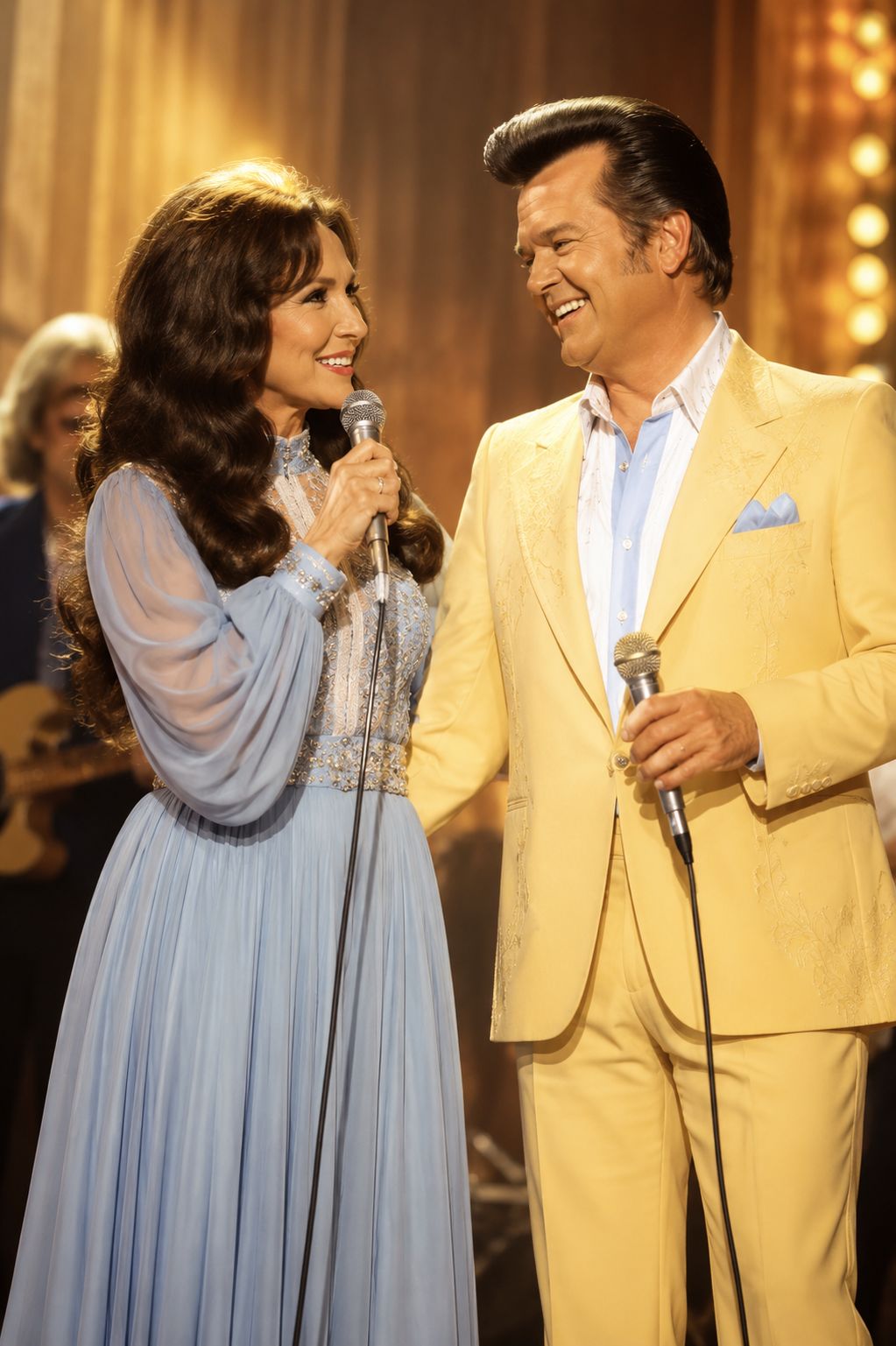
There are country duos who make beautiful records.
And then there are duos who seem to understand something about each other that the audience can feel before the first verse is even finished.
Conway Twitty and Loretta Lynn were that kind of duo.
Their voices did not simply blend. They collided, answered, challenged, teased, and ultimately completed one another. Behind the polished performances and unforgettable melodies was something much more human: two enormously successful artists who understood heartbreak, complicated love, loneliness, temptation, family, and the fragile emotions that make country music feel like real life.
When they stepped behind a microphone together, they did not need to pretend that life was perfect.
They sang about what happened when it wasn’t.
And that may be the secret to why their music has survived for generations.
The partnership officially began in the early 1970s, when both artists were already established stars in their own right. Loretta Lynn had become one of country music’s most important female voices, while Conway Twitty had built an extraordinary career as a singer and songwriter. According to the Country Music Hall of Fame, their first recording together, “After the Fire Is Gone,” reached No. 1 in 1971 and launched one of the most successful duet partnerships in country music history.
But the magic was never simply about having two famous names on the same record.
It was about contrast.
Conway’s voice carried a deep, controlled ache. Loretta’s delivery could be vulnerable one moment and fiercely confident the next. Put those voices together, and suddenly a song could sound like an entire relationship unfolding in three minutes.
They didn’t sing heartbreak from a distance. They made it sound like something happening right there in the room.
THE SONG THAT STARTED THE FIRE
“After the Fire Is Gone” was an unlikely foundation for a legendary partnership because it did not present love as something clean or uncomplicated.
Instead, the song explored emotional emptiness—the kind of loneliness that can exist even when two people are technically together.
That was classic country storytelling.
No easy answers.
No perfect endings.
Just people trying to make sense of feelings they could not always control.
The record reached the top of the country chart and immediately demonstrated what happened when Twitty and Lynn shared a song. Their voices created tension without requiring theatrical exaggeration.
The chemistry was subtle.
And that subtlety made it powerful.
The Country Music Hall of Fame notes that Lynn and Twitty went on to become CMA Vocal Duo of the Year from 1972 through 1975, while their catalog produced major hits including “Lead Me On,” “Louisiana Woman, Mississippi Man,” and “Feelins’.”
PBS’s American Masters documents the scale of their partnership: they recorded 11 studio albums together between 1971 and 1988, with five No. 1 songs coming from five different albums.
That wasn’t a lucky accident.
It was a musical language.
TWO PEOPLE — ONE MUSICAL CONVERSATION
One of the reasons Conway and Loretta remain so fascinating is that their performances rarely felt like two singers taking turns.
They sounded like they were talking.
Conway would deliver a line.
Loretta would answer.
One voice would push emotionally, and the other would pull back.
Then, suddenly, they would come together.
That call-and-response structure became one of the signatures of their partnership.
Consider “Louisiana Woman, Mississippi Man.”
The song was playful, energetic, romantic, and full of personality. It turned geography into a metaphor for desire and connection. PBS notes that the 1973 album reached No. 1 on the country charts, as did the title song.
The performance worked because the two singers sounded as though they were genuinely enjoying the conversation.
And audiences noticed.
People began projecting a romantic story onto them.
But Loretta herself pushed back against that idea.
In the PBS American Masters material, she explained that she and Conway were friends and emphasized that the supposed romance was not real. She also described the warmth between Conway and her husband, Mooney Lynn.
That distinction is important.
Their chemistry was real.
The romance was the performance.
And perhaps that makes the achievement even more impressive.
They could create believable emotional intimacy without needing to turn their private lives into a spectacle.
THE HEARTBREAK WAS PART OF THE MAGIC
Country music has always understood something pop music sometimes forgets:
Heartbreak doesn’t have to be pretty to be beautiful.
Conway Twitty understood that deeply.
His solo catalog was filled with songs about longing, guilt, infidelity, regret, and emotional conflict. The Country Music Hall of Fame describes many of his songs as combining infidelity with guilt—a formula that became part of his distinctive country persona.
Loretta approached emotional storytelling from another direction.
She brought the perspective of a woman who had spent her life observing relationships, marriage, family, hardship, independence, and the expectations placed upon women.
Her songwriting could be blunt.
Sometimes funny.
Sometimes angry.
Sometimes heartbreaking.
Together, those perspectives created something bigger than either artist could create alone.
Their songs became miniature dramas.
A husband.
A wife.
A lover.
A stranger.
A temptation.
A goodbye.
A second chance.
A love that had gone cold.
A love that refused to disappear.
Conway brought the ache. Loretta brought the truth. Together, they turned emotional conflict into harmony.
WHY THEIR DUETS STILL FEEL DIFFERENT
Listen to many modern duets and the structure can feel predictable.
One singer takes a verse.
The other singer takes another.
Then they meet in the chorus.
Conway and Loretta often felt different.
Their voices seemed to exist inside the same emotional space.
That is why artists who came after them have continued to admire the pairing.
In PBS’s feature on their duets, Garth Brooks described the effect of their voices coming together as creating a dimension that did not exist when either singer performed alone. Trisha Yearwood similarly discussed the unique energy created when two voices interact rather than simply sing separately.
That’s the secret.
A great duet isn’t necessarily about having two great singers.
It’s about creating a third voice from the relationship between them.
Conway and Loretta found that third voice.
“LOUISIANA WOMAN, MISSISSIPPI MAN” AND THE JOY OF CONTRAST
If “After the Fire Is Gone” represented the darker side of relationships, “Louisiana Woman, Mississippi Man” showed another side of their partnership.
It was bright.
Playful.
Confident.
Alive.
The song’s success proved that their chemistry wasn’t dependent on sadness.
They could flirt musically.
They could joke.
They could sound rebellious.
They could sound deeply in love.
And they could switch between those emotional colors without losing their identity.
That versatility helped turn their partnership into one of the defining male-female duos in country music.
Their five consecutive No. 1 country hits included “After the Fire Is Gone,” “Lead Me On,” “Louisiana Woman, Mississippi Man,” “As Soon as I Hang Up the Phone,” and “Feelins’.”
That is an extraordinary run.
But the numbers only tell part of the story.
The deeper achievement was that listeners believed them.
BEYOND THE RECORDS
The partnership became so successful that Conway and Loretta’s names became almost inseparable in the country music imagination.
They weren’t simply two solo artists who occasionally recorded together.
They became a musical institution.
The Country Music Hall of Fame records that they won four consecutive CMA Vocal Duo of the Year awards from 1972 through 1975. Twitty’s Hall of Fame profile also notes that the pair won a Grammy for their classic duets.
Yet what makes their story especially poignant is that it did not last forever.
They eventually stopped touring together full-time in 1981.
Conway died on June 5, 1993.
Loretta continued building her own extraordinary legacy for decades.
But something about the Conway-Loretta era remained frozen in time.
A particular sound.
A particular chemistry.
A particular moment in country music when two voices could tell complicated stories without needing to explain everything.
THE LEGACY THAT REFUSED TO DISAPPEAR
Perhaps the greatest proof that Conway and Loretta mattered is what happened after they were gone.
Their music continued to be performed.
Their recordings continued to introduce new generations to classic country.
And even members of their own families eventually stepped into the spotlight to celebrate that legacy.
Tre Twitty, Conway’s grandson, and Tayla Lynn, Loretta’s granddaughter, created Twitty & Lynn, performing the grandparents’ music and bringing songs such as “Louisiana Woman, Mississippi Man” and “After the Fire Is Gone” to modern audiences. They even performed at the Grand Ole Opry in 2022.
That continuation says something powerful.
The story didn’t really end.
The voices disappeared, but the conversation continued.
WHAT CONWAY AND LORETTA REALLY LEFT BEHIND
It is easy to remember Conway Twitty and Loretta Lynn for the awards.
For the No. 1 records.
For the glamorous television appearances.
For the unforgettable outfits.
For the songs that remain staples of classic-country playlists.
But the deeper legacy is emotional.
They showed country music that heartbreak could become art.
They showed that a duet could be more than two voices.
They showed that chemistry could exist without romance.
And they proved that sometimes the most powerful love songs aren’t about perfect love at all.
They’re about complicated people trying to survive imperfect lives.
Their greatest harmony wasn’t created because they had identical stories. It was created because they understood each other’s differences.
Conway had his darkness.
Loretta had her fire.
Conway had his mysterious restraint.
Loretta had her fearless honesty.
And when those qualities met in the studio or onstage, something unforgettable happened.
They turned conflict into conversation.
They turned loneliness into melody.
They turned heartbreak into harmony.
And decades later, that harmony still sounds alive.
Maybe that’s why Conway Twitty and Loretta Lynn remain so difficult to replace.
Country music has produced countless duets since their era.
There have been bigger productions.
More elaborate arrangements.
More sophisticated recording technology.
But technology cannot manufacture chemistry.
It cannot manufacture trust.
It cannot manufacture the feeling of two people knowing exactly when to lean into a line—and exactly when to let the other voice breathe.
Conway Twitty and Loretta Lynn had that instinct.
And that is why their partnership wasn’t simply a chapter in country music history.
It became part of the language of country music itself.
Their songs remind us that love can be complicated, that heartbreak can be beautiful, and that sometimes the strongest memories are born from the moments when everything seems to be falling apart.
They didn’t hide the cracks.
They sang through them.
And somehow, together, they made the cracks shine.
VIDEO: