 By admin
 INTRODUCTION:
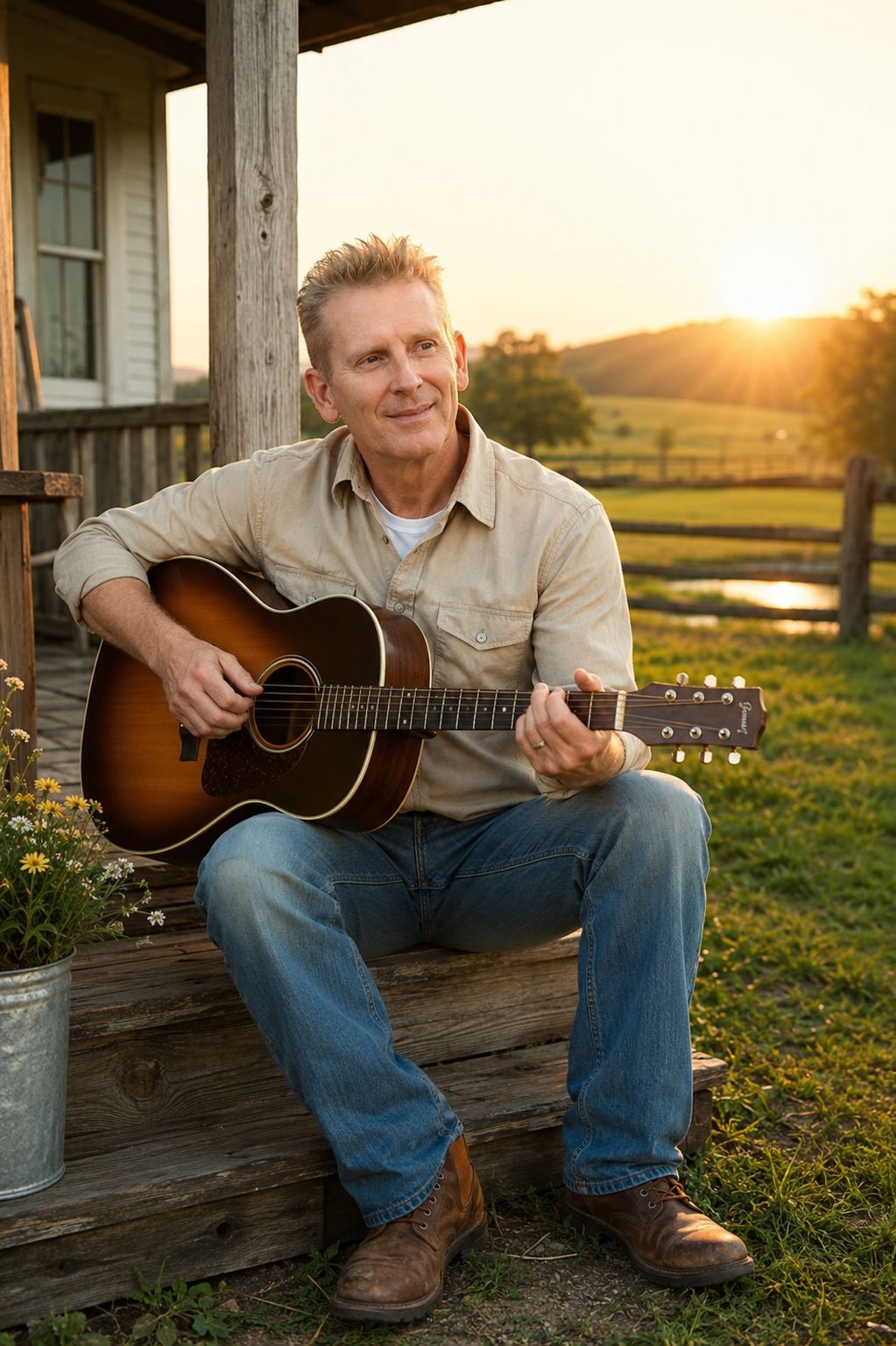
There are country stars who seem born for the spotlight.
They chase arenas, collect awards, release albums, appear on television, and build careers that become larger than life. Their names stay on marquees long after the music stops.
And then there is Rory Feek.
For much of his career, Rory seemed almost deliberately uncomfortable with the idea of celebrity. He was the songwriter behind major country hits, the husband-and-wife duo Joey + Rory, and a familiar face to country fans who loved the couple’s old-fashioned music, humor, faith, and life on their Tennessee farm.
But Rory’s most powerful story may have begun when the applause faded.
Because after the stages became quieter, after his wife Joey Feek died of cancer in 2016, and after the country-music world moved forward, Rory was left with something much harder than a career to manage:
A life.
And he chose to live it differently.
BEFORE THE FAME, THERE WAS ALWAYS THE FARM
Rory Feek never seemed particularly interested in separating music from ordinary life.
Long before audiences knew him as half of Joey + Rory, he was a songwriter who worked his way through Nashville and eventually wrote successful songs recorded by artists including Blake Shelton, Easton Corbin, Collin Raye, and Clay Walker. The Country Music Hall of Fame and Museum notes that Rory eventually moved from writing for other artists toward making music with Joey.
But the remarkable thing about Rory was that success never completely erased the man underneath it.
The farmhouse mattered.
The land mattered.
Family mattered.
And when Rory and Joey became a recording and performing duo, their home life became part of their artistic identity.
They were not selling an imaginary version of country life. They were inviting audiences into something that felt remarkably ordinary.
That authenticity became one of their greatest strengths.
Their television show brought viewers into their farmhouse. Their barn became a concert space. Their songs often celebrated family, faith, work, marriage, and the simple things that modern life can make easy to overlook.
Then everything changed.
THE MOMENT THE MUSIC STOPPED BEING THE MOST IMPORTANT THING
Joey’s illness transformed Rory’s life in a way no career achievement ever could.
The couple welcomed their daughter, Indiana, in 2014. Soon afterward, Joey was diagnosed with cervical cancer. She continued fighting while Rory documented their family’s journey, and their story eventually reached far beyond country music.
Joey died on March 4, 2016, at just 40 years old.
The timing made the tragedy even more haunting.
Their album Hymns That Are Important to Us had become a major success, eventually winning the Grammy for Best Roots Gospel Album.
The music was succeeding.
But Rory was losing his wife.
That contradiction became one of the defining images of his life: the world celebrating the music while a family was preparing for goodbye.
Rory later admitted that he wasn’t ready.
“None of us are.”
Those words capture something far more universal than celebrity grief.
There is no amount of success that prepares someone for losing the person they built a life with.
In a 2016 interview with CBS, Rory explained that he initially didn’t want to perform without Joey. He said he had not loved being on stage for its own sake; what he loved was standing beside her.
That revelation changes how we understand Rory’s career.
Perhaps the stage was never really the destination.
Perhaps Joey was.
WHEN A COUNTRY STAR PUT DOWN THE GUITAR
After Joey’s death, Rory stepped away from the center of the music business.
That could easily have become the end of his public story.
Instead, it became the beginning of a different one.
Rory turned toward writing.
His blog, This Life I Live, became a place where he processed grief, fatherhood, faith, memory, and the strange task of continuing to live when the person you expected to grow old with is suddenly gone.
His writing eventually became his memoir, This Life I Live: One Man’s Extraordinary, Ordinary Life and the Woman Who Changed It Forever. The Country Music Hall of Fame describes the book as an extension of Rory’s reflections on his childhood, marriage, family, music, and grief.
That phrase — ordinary life — may be the key to understanding Rory Feek.
Because Rory’s story has never really been about becoming extraordinary.
It has been about discovering extraordinary meaning inside ordinary things.
A porch.
A cup of coffee.
A daughter walking across a driveway.
A song remembered.
A grave on the family property.
A schoolhouse filled with children.
Those details may not sound like the ingredients of a country-music legend.
But they are.
HIS GREATEST STAGE MAY HAVE BEEN THE SCHOOLHOUSE
One of the most remarkable chapters of Rory’s post-fame life was the creation of a one-room schoolhouse on the family farm.
After Joey’s death, Rory wanted to honor what she had hoped for their daughter, Indiana. He used money sent by fans after Joey’s passing toward creating a school environment close to home. The resulting Hardison Mill School opened on the farm and welcomed other children as well.
That decision says something profound about Rory.
He could have spent the rest of his life simply preserving Joey’s memory.
Instead, he tried to build something that would help create a future.
And that distinction matters.
Grief can make people look backward.
Purpose makes them look forward.
Rory tried to do both.
He remembered Joey while raising Indiana.
He carried the past while building something new.
And eventually, the farm became more than a home. It became a place where music, education, family, community, and storytelling could exist together.
A recent Guideposts interview highlighted how meaningful the schoolhouse became to Rory, describing his excitement at seeing children, teachers, and parents bringing new life to the farm.
That may be one of the quietest forms of success imaginable.
No sold-out arena.
No flashing lights.
Just children walking into school.
And a father watching them.
THE LEGACY OF JOEY DIDN’T END WITH HER
Perhaps the most moving part of Rory’s story is that he never treated Joey’s death as the end of her influence.
He continued to speak about her.
He continued to preserve her music.
He continued to raise their daughter surrounded by memories of her mother.
And he continued to see Joey not simply as someone he had lost, but as someone whose influence remained woven into his everyday life.
In a later interview, Rory described Joey’s presence as something he could still feel in the house and in their family. He explained that her legacy was embedded in the land, the music, and the community they had built together.
That is a different definition of remembrance.
It isn’t putting a photograph on a wall and walking away.
It’s allowing someone’s values to continue shaping the way you live.
“Her legacy” was not simply something to remember. It became something to live.
And that may be why Rory’s story continues to resonate with country fans.
Because everyone understands loss.
Not everyone understands what to do with it.
THE QUIET MAN LEARNED TO SPEAK THROUGH LIFE
Rory was never the loudest personality in country music.
He didn’t need to be.
His greatest strength was observation.
He noticed the little things.
The kitchen table.
The farm.
The children.
The songs.
The memories.
The silence after someone leaves.
That sensitivity became even more important after Joey’s death.
In fact, one could argue that Rory became a more powerful storyteller after he stopped trying to be a traditional entertainer.
His instrument changed.
The guitar became the pen.
The stage became the page.
The audience became anyone who had ever experienced heartbreak, parenthood, faith, marriage, or the frightening uncertainty of starting over.
Publishers Weekly noted that after Joey’s death, Rory put down his guitar and found another creative outlet through writing.
That is why the phrase “life after fame” doesn’t quite describe Rory’s journey.
He didn’t simply leave fame behind.
He redefined what mattered.
AND THEN CAME THE MOST DIFFICULT PART: MOVING FORWARD
Moving forward after devastating loss is often misunderstood.
People sometimes assume that healing means forgetting.
Rory’s story suggests something different.
Moving forward can mean carrying the past without allowing it to prevent the future.
In recent years, Rory has continued developing life on the farm and has also found love again, marrying Rebecca in 2024.
For some fans, that chapter may feel complicated because of how deeply Rory and Joey’s love story was embedded in his public identity.
But perhaps that is precisely what makes it human.
A person can remember someone forever and still continue living.
Love does not necessarily disappear because life changes.
Memory and new beginnings can occupy the same heart.
And that might be one of the most difficult lessons Rory’s story offers.
THE REAL SUCCESS STORY
If you only measure Rory Feek’s career by chart positions, songwriting credits, awards, television appearances, and albums, you miss the bigger picture.
Yes, he was a successful songwriter.
Yes, Joey + Rory became beloved in country music.
Yes, their music earned major recognition.
But Rory’s most consequential work may have happened away from the recording studio.
He became a father navigating unimaginable loss.
He became a writer.
He became a keeper of memories.
He became someone trying to turn grief into purpose.
And he built a life where the things he once sang about — family, faith, home, sacrifice, and love — became more than lyrics.
They became responsibilities.
That is why Rory Feek’s post-fame story may be more powerful than his fame itself.
Because fame tells us what a person accomplished.
Life tells us who they became.
And Rory’s story is ultimately about becoming.
Becoming a father again after loss.
Becoming a storyteller after silence.
Becoming comfortable with a quieter life.
Becoming willing to love again.
And learning that the greatest audience may not be the thousands sitting in front of a stage.
Sometimes it is one child.
One family.
One community.
One person sitting quietly on a porch, remembering someone they loved.
“The loudest stories aren’t always told under bright lights. Sometimes they are lived quietly, one ordinary day at a time.”
That may be Rory Feek’s greatest lesson.
The country music world gave him a stage.
Joey gave him a love story.
Grief gave him a deeper voice.
And life after fame gave him the chance to discover what the applause could never provide:
purpose.
Maybe that is why Rory’s story still feels unfinished.
Because the most meaningful chapter was never about becoming famous.
It was about discovering what was worth living for after the fame was gone.
VIDEO: