 By admin
 INTRODUCTION:
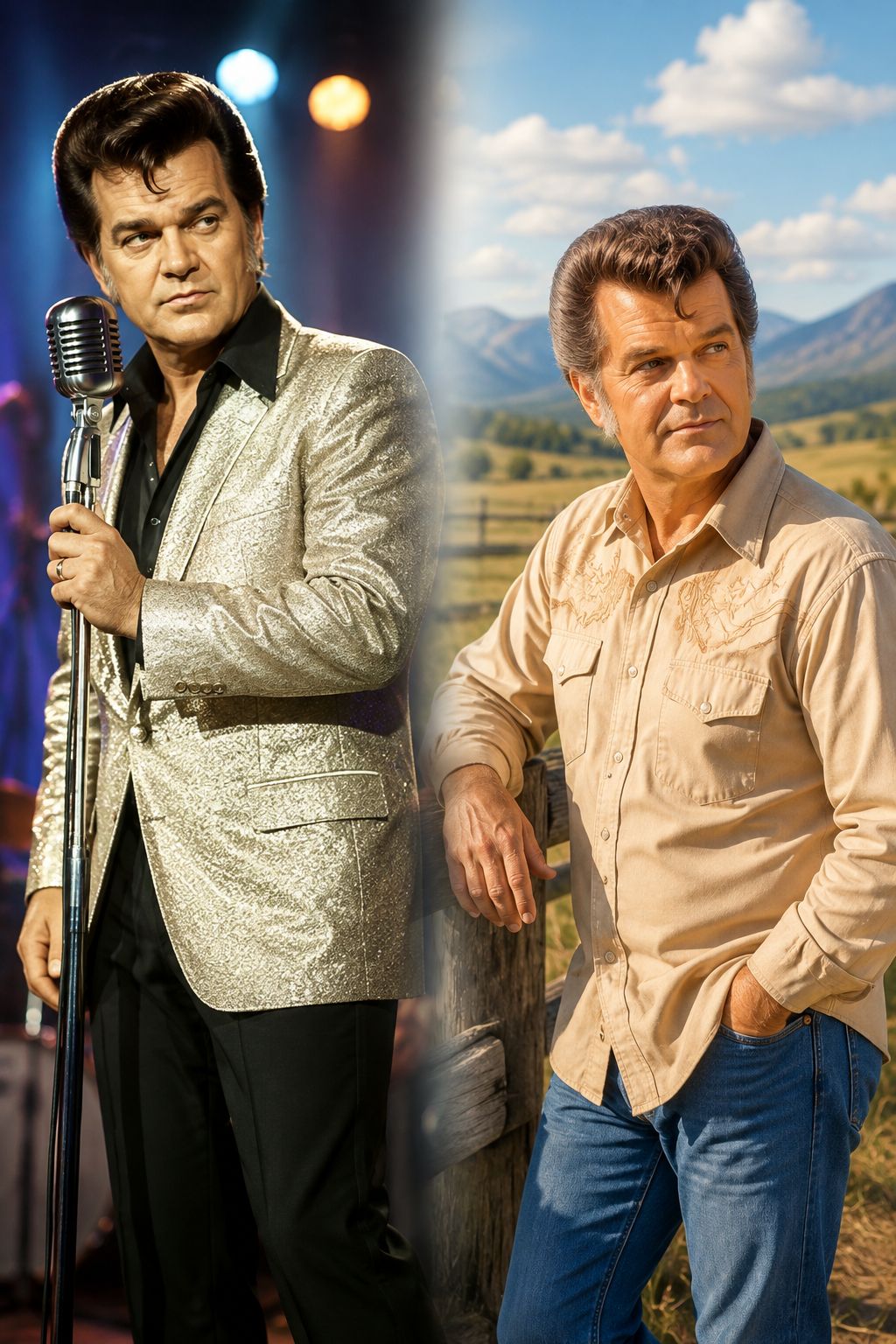
There are moments in music history when a career is changed by a hit record.
And then there are moments when a career is changed by walking away.
For Conway Twitty, the most important decision of his life did not happen beneath a spotlight while thousands of fans screamed his name. It happened in a New Jersey nightclub, at a moment when the singer had everything a young entertainer was supposed to want—and suddenly realized he wanted something completely different.
By then, Twitty had already tasted the dizzying rewards of rock ’n’ roll.
He had been a teen idol.
He had conquered the pop charts.
He had movies, television appearances, screaming fans, and a million-selling signature song.
Yet somewhere beneath the slick hair, rockabilly rhythm, and teenage hysteria was another Conway Twitty—a man who had grown up surrounded by country music, gospel, blues, and the ordinary struggles of Southern life.
That man was still waiting to come home.
And when he finally did, he would become one of the most successful country artists the world had ever seen.
THE MAN BEFORE CONWAY TWITTY
Before the famous name, there was Harold Lloyd Jenkins.
Born in Friars Point, Mississippi, in 1933, Jenkins grew up with music practically woven into his childhood. He learned guitar as a young boy and eventually performed on radio in Helena, Arkansas. His early musical world was not confined to one genre. Country music, blues, gospel, and the sounds coming from the South all left their fingerprints on him.
But Jenkins initially imagined another future.
Baseball was one possibility. Music was another.
Then came Elvis Presley.
After military service, Jenkins heard Presley and was stunned by the possibilities of this new sound. Rock ’n’ roll seemed to combine elements he already understood—country, blues, and gospel—but turn them into something explosive and modern.
So the young singer headed toward Memphis and Sun Records.
The country boy was about to become a rock ’n’ roll star.
“IT’S ONLY MAKE BELIEVE” CHANGED EVERYTHING
The transformation from Harold Jenkins to Conway Twitty was deliberate. The new name was created by combining Conway, Arkansas, with Twitty, Texas—a name designed to be memorable in the rapidly changing world of popular music.
Then, in 1958, everything exploded.
“It’s Only Make Believe” became a massive pop success, reaching No. 1 and establishing Twitty as a legitimate teen idol. His Elvis-influenced vocal style, dramatic delivery, and striking appearance made him perfectly suited to the era.
Suddenly, Conway Twitty wasn’t just another singer trying to make it.
He was famous.
He toured with major stars. He appeared on television. He entered the world of movies. The Broadway musical Bye Bye Birdie even created the fictional teen idol Conrad Birdie, a character widely understood to have been modeled in part on Twitty and the teen-idol phenomenon he represented.
From the outside, it looked like the dream had come true.
But inside, something was missing.
“The hits were there. The fame was there. But the music he truly loved was still calling him home.”
THE PROBLEM WITH SUCCESS
The strange thing about Conway Twitty’s story is that he wasn’t necessarily running away from failure.
He was running away from a version of success that no longer felt like his own.
By the early 1960s, the enormous momentum of his initial pop career had begun to fade. His singles were no longer dominating the charts as they once had, and the teen-idol world was changing.
But Twitty had another problem.
He had never stopped loving country music.
Even while performing rock ’n’ roll, he continued writing country songs. He knew the sound. He understood the emotions. More importantly, he felt that country music told the truth about everyday life in a way that spoke directly to him.
The longer he stayed in rock ’n’ roll, the more he wondered whether he was spending his life performing the wrong version of himself.
And then came the night that changed everything.
THE NIGHT HE WALKED OFF THE STAGE
According to accounts of Twitty’s career, he was performing at a New Jersey nightclub after an extended run of rock ’n’ roll shows.
He had been told that he would eventually be able to move into country music.
Instead, contracts arrived for more rock ’n’ roll dates—more clubs, more touring, more of the same.
The future seemed to have already been decided for him.
And Conway Twitty didn’t like what he saw.
He was a husband.
He had children.
He had responsibilities.
And suddenly the idea of spending years playing the same kind of shows for the same teenage audience felt unbearable.
So, in one of the boldest decisions of his career, he walked off the stage.
Not after a farewell concert.
Not after securing a new country record deal.
Not after guaranteeing that Nashville would welcome him.
He simply decided that he was finished.
That decision was risky enough to destroy his career.
Instead, it created his legacy.
He didn’t leave rock ’n’ roll because he couldn’t succeed in it. He left because he finally understood where he belonged.
NASHVILLE DIDN’T IMMEDIATELY WELCOME HIM
Today, it is easy to look backward and imagine that Conway Twitty simply changed genres and became a country superstar.
The reality was much harder.
Country radio had reasons to be skeptical.
Twitty was known as a former pop star and teen idol. He had the image. He had the history. He had spent years singing rock ’n’ roll.
Why should Nashville believe he was serious about country music?
The answer had to come through the songs.
Songwriter Harlan Howard played an important role in helping Twitty connect with the Nashville establishment, including producer Owen Bradley, who eventually signed Twitty to Decca in 1965.
But the transition was not instant.
Twitty released country records that initially struggled to make a major impact.
Then something began to happen.
Country listeners started hearing beyond the old teen-idol image.
They heard a voice capable of heartbreak.
They heard vulnerability.
They heard maturity.
They heard a man who sounded as though he understood exactly what it meant to lose someone.
And slowly, the resistance disappeared.
“NEXT IN LINE” — THE DOOR FINALLY OPENS
In 1968, “The Image of Me” helped establish Twitty in the country Top Ten.
Then came “Next in Line.”
It became his first country No. 1.
The former rock ’n’ roll idol had officially arrived in Nashville.
And once the door opened, it seemed almost impossible to close it.
Twitty developed one of the most extraordinary hit-making runs in country music history.
Songs such as “Hello Darlin’,” “Fifteen Years Ago,” “To See My Angel Cry,” and many others transformed him from an unlikely newcomer into one of country music’s defining voices.
His emotional delivery became his weapon.
He didn’t need to scream.
He didn’t need to prove anything.
He could take a simple lyric and make it feel like a private confession whispered across a kitchen table at midnight.
That was the magic.
THEN CAME LORETTA LYNN
If Twitty’s solo career established him as a country giant, his partnership with Loretta Lynn created another chapter entirely.
Their duets worked because they didn’t sound manufactured.
They sounded conversational.
Sometimes playful.
Sometimes argumentative.
Sometimes heartbreaking.
And often all three at once.
Songs such as “After the Fire Is Gone” and “Louisiana Woman, Mississippi Man” became part of the musical identity of an era.
Their chemistry showed another side of Twitty: the ability to listen.
He wasn’t simply trying to dominate the song.
He understood that country duets depended on tension between two voices—two personalities, two perspectives, two emotional worlds.
Together, Conway and Loretta became one of the most memorable partnerships in country music.
THE VOICE THAT TURNED RISK INTO REWARD
Twitty’s greatest achievement wasn’t simply the number of records he sold or the number of chart-toppers attached to his name.
It was his ability to reinvent himself without losing the emotional core of who he was.
The Country Music Hall of Fame notes that Twitty’s stardom endured through five decades of changing musical fashions and that he had more No. 1 records than any country artist had achieved at that point. Eleven of those No. 1 hits were songs he wrote himself.
Think about what that means.
A man who began as Harold Lloyd Jenkins.
A young musician inspired by Elvis Presley.
A rockabilly performer.
A teen idol.
A movie personality.
A fading pop star.
Then, against advice and expectation, a country singer.
Then a country superstar.
Then a legend.
The irony is beautiful.
The very decision that appeared to put his career in danger became the foundation of his greatest success.
HE DIDN’T JUST CHANGE GENRES—HE CHANGED HIS LIFE
There is a lesson buried inside Conway Twitty’s story that goes far beyond country music.
Sometimes the most dangerous career decision is not changing direction.
Sometimes it is refusing to change when you already know the direction is wrong.
Twitty could have remained a successful nostalgia act.
He could have continued chasing another pop hit.
He could have accepted the contracts, played the clubs, and continued living inside the identity that had made him famous.
Instead, he chose uncertainty.
He chose country music.
And perhaps most importantly, he chose authenticity.
“He had already conquered one world. The real victory was having the courage to leave it behind and build another.”
That is why Conway Twitty’s transition remains so fascinating decades later.
He didn’t become country royalty because Nashville handed him a crown.
He earned it one song at a time.
He earned it after being doubted.
He earned it after his pop fame began to fade.
He earned it after walking away from a career path that seemed safer.
And he earned it by proving that sometimes an artist has to risk everything familiar to become the person the audience will remember.
THE LEGACY OF THE RISK
Conway Twitty died on June 5, 1993, at the age of 59, but his legacy had already become enormous. He was inducted into the Country Music Hall of Fame in 1999, cementing his place among the genre’s most important figures.
His story remains powerful because it doesn’t fit the usual comeback narrative.
This wasn’t simply a forgotten singer finding another hit.
This was a star choosing to become someone else.
And in doing so, he discovered who he had been all along.
The rock ’n’ roll years were not wasted.
They gave him confidence.
They gave him an audience.
They gave him experience.
They gave him a distinctive voice.
But country music gave those pieces a home.
Perhaps Conway Twitty said it best when reflecting on his journey from rock toward country: he viewed it as having started with rock and worked his way toward country, because he needed to live enough life to understand the emotions inside a country song.
That may be the real secret behind his longevity.
He didn’t simply sing about heartbreak.
He understood it.
He didn’t simply sing about longing.
He had lived with it.
And when Conway Twitty finally stood in front of a country audience, he wasn’t pretending to be someone he wasn’t.
He was finally singing as the man he had always wanted to become.
From rock ’n’ roll rebel to country royalty, Conway Twitty proved that the riskiest turn in a career can sometimes become the most important decision of a lifetime.
And perhaps that is why, all these years later, his voice still feels less like a relic of country music history—and more like an old friend telling us that sometimes, the road we are most afraid to take is the one that leads us home.
VIDEO: