 By admin
INTRODUCTION:
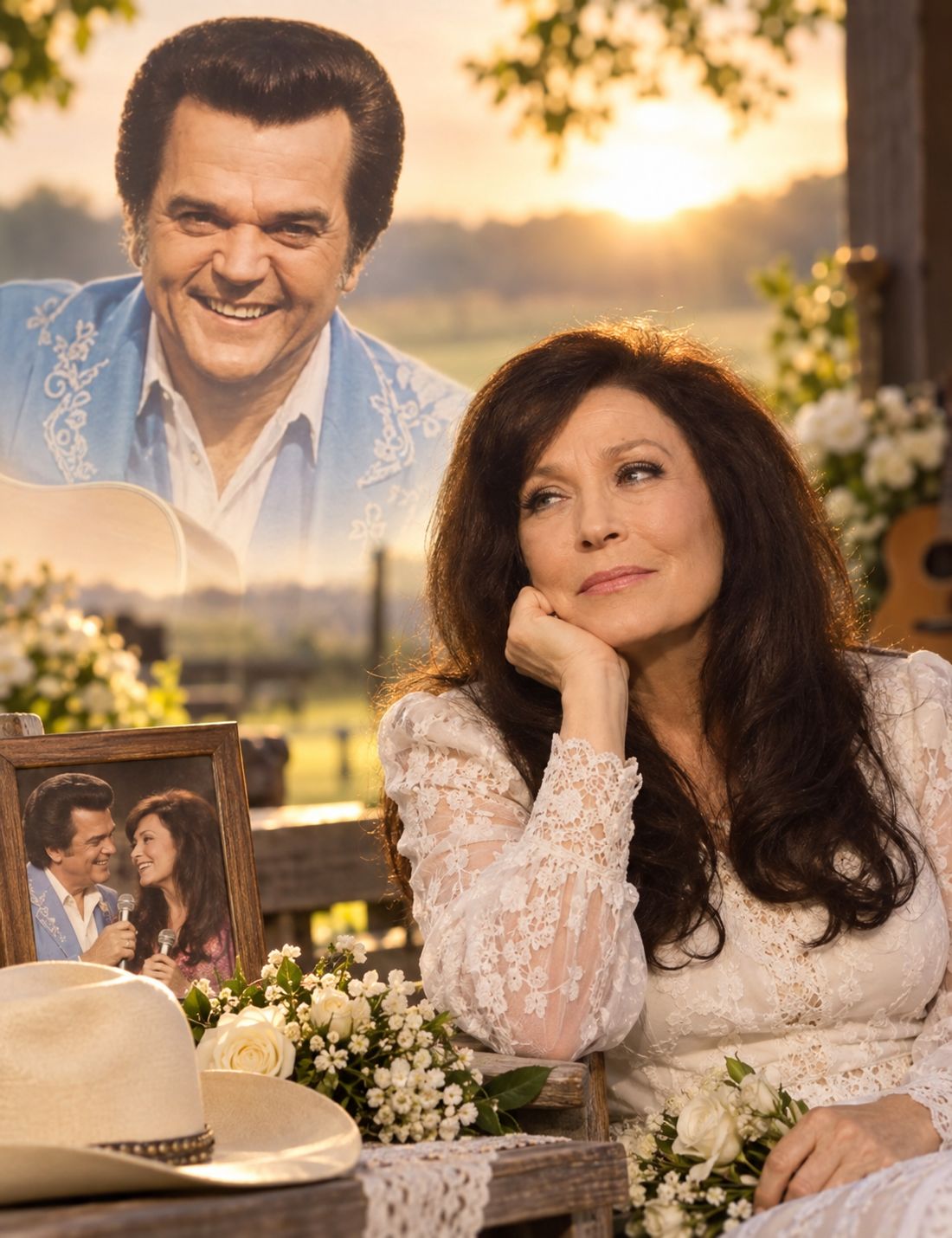
There are some songs a singer performs.
And then there are songs that carry a person’s memory so deeply that singing them again feels almost impossible.
For Loretta Lynn, her legendary duets with Conway Twitty belonged to that second category.
For more than a decade, Lynn and Twitty created some of the most unforgettable recordings in country music history. Their voices seemed to fit together almost effortlessly—sometimes tender, sometimes playful, sometimes dangerously intimate. Songs like “After the Fire Is Gone,” “Lead Me On,” “Louisiana Woman, Mississippi Man,” and “You’re the Reason Our Kids Are Ugly” became country classics.
But behind those records was something much more complicated than a successful musical partnership.
It was friendship. Trust. History. Family connection. And, eventually, grief.
When Conway Twitty died suddenly on June 5, 1993, at just 59 years old after suffering an abdominal aneurysm, the country world lost one of its biggest stars. Lynn lost something much more personal.
And that loss helps explain why, in the years that followed, she rarely treated those famous Conway-Loretta songs as ordinary material.
“Me and Conway was just kind of like one.”
That simple sentiment, expressed by Lynn years later, reveals more than decades of speculation ever could.
The Partnership That Sounded Too Real
From the very beginning, Lynn and Twitty had an unusual chemistry.
They had first admired each other before they became recording partners. Twitty was already a star in his own right, while Lynn had become one of country music’s most distinctive voices.
Their collaboration grew almost casually.
While touring overseas, the two began singing together backstage and in dressing rooms. They liked what they heard and decided to take the idea back to producer Owen Bradley.
Bradley heard something special.
The rest became history.
Their first major success, “After the Fire Is Gone,” reached No. 1 on the country chart and earned them a Grammy. The pair subsequently won the CMA Vocal Duo of the Year award four consecutive times, from 1972 through 1975.
But their records created a problem neither singer could completely escape.
They sounded too believable.
Their songs frequently portrayed married people tempted by forbidden love, lonely spouses searching for affection, or couples caught between desire and responsibility.
Listeners didn’t merely hear two singers.
They heard a story.
And because Lynn and Twitty delivered those stories with such conviction, fans began wondering whether something romantic existed behind the microphones.
Lynn repeatedly rejected that idea.
“Me and Conway were friends. We wasn’t lovers.”
She explained that the emotional intensity belonged to the songs—not to a secret affair between the singers.
That distinction is important.
Their chemistry was real.
Their romance was not.
But Their Friendship Was Deeper Than Fans Realized
Perhaps the most heartbreaking part of their story is that Conway wasn’t simply Lynn’s duet partner.
He was part of her personal world.
Lynn later recalled that her husband, Oliver “Doolittle” Lynn, was particularly fond of Conway. She described Conway as the one artist in the country business her husband really cared about.
Their friendship extended beyond recording studios and concert stages.
There were trips overseas, backstage jokes, long conversations, family connections and years of shared memories.
The professional partnership eventually ended as a regular touring act, but the personal affection remained.
And then came 1993.
The Day Everything Changed
The circumstances of Conway Twitty’s death make the story especially painful.
Lynn’s husband was hospitalized in Springfield, Missouri, recovering from open-heart surgery.
Twitty was performing in the Branson area and was traveling toward home. According to Lynn’s later recollection, she saw Conway’s tour bus coming off an exit near the hospital.
She assumed he was simply coming to visit Doolittle.
She went downstairs to meet him.
Instead, she saw Conway being brought into the hospital.
He was gravely ill.
He died that night.
Lynn later described the experience as devastating, particularly because she had been expecting to greet an old friend—not suddenly confront the possibility that she was watching him die.
Imagine that moment.
One minute you’re expecting to see your longtime singing partner walk through a hospital door.
The next, you’re realizing that the man whose voice had accompanied you through some of the biggest moments of your career may never speak to you again.
That kind of loss doesn’t simply disappear.
It changes the meaning of everything that came before it.
Why Singing Those Songs Could Hurt So Much
This is where the popular claim that Lynn “refused to sing” the Conway duets needs some nuance.
There is strong evidence that Lynn regarded Conway’s death as profoundly painful and that she later spoke about the difficulty of recording another duet partner after him. In a later interview, when asked about other people she might record with, she said she hadn’t thought about doing that since Conway passed away.
That’s different from saying she literally never performed any Conway song again.
In fact, her music continued to preserve their partnership, and recordings of their classic duets remained part of her legacy.
But emotionally?
That was another story.
The issue wasn’t simply whether she could remember the lyrics.
It was whether she could stand beside another singer and recreate something that, in her mind, belonged to Conway.
“I don’t know. Me and Conway was just kind of like one.”
Those words make the pain easier to understand.
A duet is inherently about connection.
One singer leaves space for the other.
One voice answers another.
Breath meets breath.
Timing becomes shared.
When your partner dies, singing the same song with somebody else can feel strangely wrong.
Not because the new singer isn’t talented.
But because the original partnership can’t be recreated.
Their Songs Were Filled With Emotional Traps
Listen to “After the Fire Is Gone.”
The song is about two people who know they shouldn’t be together but continue returning to one another because something has disappeared from their marriages.
Now imagine Lynn singing those words after Conway’s death.
The meaning changes.
Before, it was theatrical.
Afterward, it could become memory.
The same thing happened with “Lead Me On.”
And “Louisiana Woman, Mississippi Man.”
And the dozens of moments where Conway’s voice and Loretta’s voice seemed to flirt, argue, challenge and reconcile.
The magic came partly from the illusion that these two people were having a private conversation through music.
Once Conway was gone, the illusion became haunted.
The Country World Lost More Than a Singer
Twitty’s death wasn’t simply another celebrity passing.
He had been one of the defining figures of country music, accumulating an extraordinary number of No. 1 hits over his career. His partnership with Lynn was one of the most successful vocal collaborations of the era.
But for Lynn, the loss was personal.
She wasn’t mourning a chart statistic.
She was mourning the man who had stood beside her for years.
The singer who knew how she phrased a line.
The friend who could finish a musical thought without being told.
The person whose voice had become intertwined with hers.
That’s why the mythology surrounding Conway and Loretta has survived for generations.
People weren’t simply fascinated by two country stars who made great records.
They sensed that something authentic existed underneath the performance.
Not a secret marriage.
Not a hidden affair.
Something perhaps more meaningful:
deep friendship expressed through music.
And That’s What Makes Their Story So Devastating
Country music has always understood heartbreak.
But Lynn and Twitty’s story contains a special kind of heartbreak—the heartbreak of a musical partnership that could never be duplicated.
Today, performers can cover their songs.
They can recreate the harmonies.
They can stand under the lights and sing the words exactly as they were recorded.
Modern performers such as Tre Twitty and Tayla Lynn have even built a show around celebrating the musical legacy of Conway and Loretta, bringing songs such as “Louisiana Woman, Mississippi Man” and “After the Fire Is Gone” back to audiences.
But there is a difference between preserving a song and replacing the people who created it.
Nobody can replace Conway Twitty.
And nobody could recreate exactly what happened when his voice met Loretta Lynn’s.
Perhaps that’s the real reason those songs became so emotionally complicated for Lynn after his death.
She wasn’t afraid of the songs.
She was afraid of what they carried.
Every harmony could summon a memory.
Every familiar lyric could bring back a voice that would never answer again.
Every stage performance could remind her of a partnership that ended far too soon.
The Final Lesson of Conway and Loretta
For decades, fans asked whether Conway Twitty and Loretta Lynn were secretly in love.
Loretta’s answer was consistent: they were friends, not lovers.
And perhaps that’s what makes their story even more beautiful.
Because not every profound love story is romantic.
Some are about friendship.
Some are about artistic trust.
Some are about finding another person whose voice fits beside yours so perfectly that generations of listeners assume there must be something more.
There was something more.
It just wasn’t the secret affair people imagined.
It was loyalty.
Respect.
Musical chemistry.
And a friendship that survived long after the final duet was recorded.
When Conway died, Loretta didn’t simply lose a singing partner.
She lost half of a musical conversation that had lasted for years.
And once one voice disappears from a duet, the silence left behind can sometimes be louder than the music itself.
“I loved Conway. He was a great singer and a great person.”
That may ultimately be the simplest explanation for everything.
She loved her friend.
And sometimes, when a friend becomes part of the soundtrack of your life, certain songs become too precious—and too painful—to sing the same way ever again.
That is the devastating beauty of Conway Twitty and Loretta Lynn.
Their voices are still together on the recordings.
Their harmonies are still alive.
Their stories are still being sung.
But the two people who made that magic possible are gone.
And perhaps that is why, more than three decades later, those old duets still feel less like recordings from the past—and more like two friends talking across time.
VIDEO: