 By admin
INTRODUCTION:
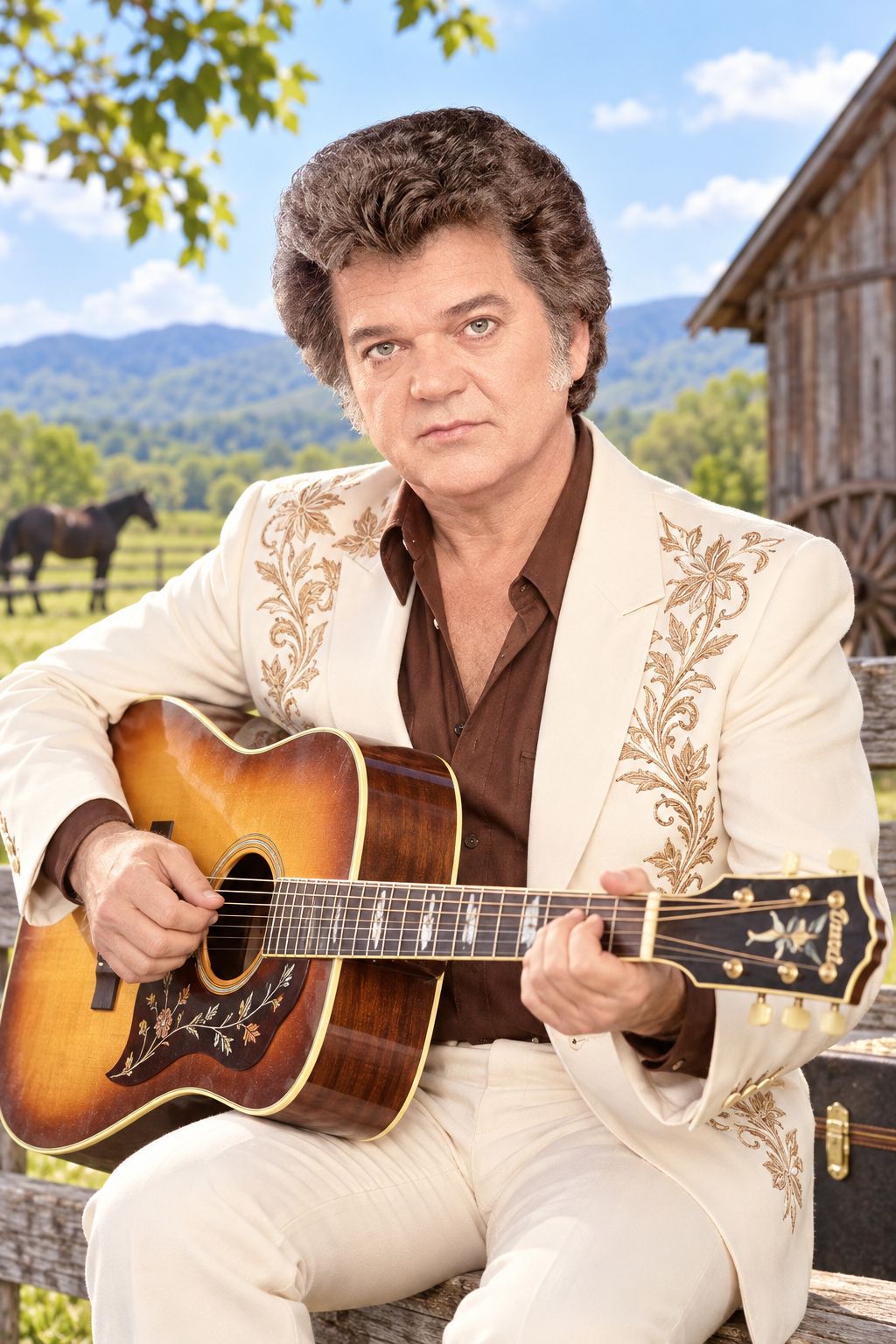
There is a strange phenomenon in country music.
Ask a younger fan to name the biggest stars in the genre, and you’re likely to hear names such as Luke Combs, Morgan Wallen, Zach Bryan, Chris Stapleton, or Jelly Roll.
But then ask a deceptively simple question:
“Have you ever heard of Conway Twitty?”
For many younger listeners, the answer may be no.
And that is astonishing.
Because before streaming playlists, viral TikTok clips, stadium-sized social-media personalities, and algorithm-driven hits, there was a man who built one of the most extraordinary careers country music had ever seen.
His name was Conway Twitty.
And according to his official biography, Twitty accumulated 55 No. 1 singles, sold more than 50 million records, performed for tens of millions of fans, and received more than 100 major awards.
The Country Music Hall of Fame offers an important distinction: Twitty earned 40 No. 1 hits on the Billboard country chart, while the larger figure of 55 reflects No. 1 rankings across the various music charts of his era.
Either way, the achievement is staggering.
And the story behind it is even more remarkable.
He Wasn’t Even Supposed to Become Conway Twitty
Long before the cowboy hats and country ballads, Conway Twitty was Harold Lloyd Jenkins, born September 1, 1933, in Friars Point, Mississippi.
Music entered his life early.
According to the Country Music Hall of Fame, he was taught guitar by his grandfather and a local blues singer, and by the age of 12 he was already performing on radio station KFFA in Helena, Arkansas.
But music wasn’t his only dream.
Twitty was also an exceptional baseball player. He was even scouted by the Philadelphia Phillies before military service interrupted that path.
Then something happened that changed everything.
He heard Elvis Presley.
The sound of rock ‘n’ roll pulled him toward Memphis and Sun Records. Suddenly, the young Mississippi musician was standing at the edge of another world.
And in 1958, he delivered the song that would permanently change his life:
“It’s Only Make Believe.”
The song became a No. 1 hit on the Billboard Hot 100.
For a moment, Conway Twitty looked like he might become another major rock-and-roll star.
But he eventually made a decision that would define his legacy.
He chose country.
The Risk That Created a Legend
Moving from pop and rock into country music wasn’t necessarily an easy transition.
Twitty had already established himself as a pop star. Country radio could have rejected him as an outsider.
And initially, there was skepticism.
But in 1968, “The Image of Me” finally broke into the country Top Ten. Then came “Next in Line.”
That song became his first Billboard country No. 1.
And from there, something almost unbelievable happened.
The hits just kept coming.
“Hello Darlin’.”
“Fifteen Years Ago.”
“How Much More Can She Stand.”
“You’ve Never Been This Far Before.”
“There’s a Honky Tonk Angel.”
“Linda on My Mind.”
These weren’t simply songs that appeared on the charts.
They were emotional dramas.
Twitty had an extraordinary ability to make complicated adult emotions sound intimate. His songs often dealt with temptation, regret, betrayal, loneliness, desire, and guilt.
He wasn’t singing about perfect people.
He was singing about people who made mistakes.
People who loved the wrong person.
People who couldn’t let go.
People who woke up one morning and realized their entire world had changed.
That emotional honesty became one of his greatest weapons.
“Twitty understood something that many singers never learn: a great country song doesn’t have to make you feel good. Sometimes it has to make you feel understood.”
Then Came Loretta Lynn
If Conway Twitty had remained a solo star, his legacy would already have been enormous.
But then came Loretta Lynn.
Together, Twitty and Lynn created one of the most celebrated partnerships in country music history.
Their first No. 1 duet, “After the Fire Is Gone,” reached the top of the Billboard country chart in 1971 and won a Grammy.
Then came songs such as:
“Lead Me On.”
“Louisiana Woman, Mississippi Man.”
“As Soon as I Hang Up the Phone.”
“Feelin’s.”
Their chemistry was undeniable.
There was tension in their voices. Sometimes tenderness. Sometimes conflict.
It sounded like two people having a private conversation in the middle of a crowded room.
The Country Music Hall of Fame notes that Twitty and Lynn won a Grammy and four CMA awards for their classic duet recordings.
And this is one of the reasons Twitty remains so important.
He didn’t simply have hits.
He helped define what a country duet could be.
“Hello Darlin’” Was More Than a Song
If there is one recording that explains the Conway Twitty phenomenon, it may be “Hello Darlin’.”
The opening itself is unforgettable.
There is no elaborate introduction.
No complicated production.
Just a voice speaking directly to someone from the past.
And suddenly, the listener is inside the story.
That was Twitty’s gift.
He could make thousands of people feel as if he were singing to one person.
His concerts developed an almost legendary following. The Country Music Hall of Fame notes that his female fan base could turn performances into something resembling religious revivals, inspiring comedian Jerry Clower to call him “The High Priest of Country Music.”
That’s an extraordinary description.
But perhaps the strangest thing about Twitty’s performance style was how little he relied on traditional showmanship.
For years, he rarely spoke onstage, avoided many interviews and music-business parties, and didn’t even perform encores.
He let the songs do the talking.
He Refused to Stay Frozen in Time
Another reason Twitty’s career was so remarkable is that he refused to become trapped in his own past.
By the late 1970s and early 1980s, country music was changing.
So was Conway Twitty.
He experimented with rock, soul, and outlaw-country influences. He changed his hairstyle. His production became more contemporary.
Then came songs such as “I’d Love to Lay You Down,” “Tight Fittin’ Jeans,” “Slow Hand,” and “The Rose.”
He wasn’t desperately trying to become young again.
He was adapting.
That distinction matters.
Many artists spend their careers chasing the sound that made them famous.
Twitty kept chasing the audience.
And that’s one reason he remained commercially powerful for so long.
The Man Behind the Hits
Perhaps the most overlooked part of Conway Twitty’s story is what he did for other artists.
The Country Music Hall of Fame notes that artists including Vince Gill, Kathy Mattea, Naomi Judd, and Reba McEntire were among those whose early careers he helped.
Songwriters also respected him enormously.
He became known in Nashville as “the best friend a song ever had.”
That phrase tells us something important.
Twitty wasn’t simply interested in being famous.
He understood that country music begins with the song.
And he understood that the person writing the song mattered.
His own songwriting credentials were impressive as well. Eleven of his Billboard country No. 1 hits were self-penned, according to the Country Music Hall of Fame.
That means the man behind the microphone was also deeply involved in the storytelling.
So Why Doesn’t Gen Z Know Him?
This is where the Conway Twitty story becomes bittersweet.
How can someone with a career this enormous become unfamiliar to an entire generation?
The answer isn’t necessarily that younger listeners don’t care about country music.
It’s that music history has changed.
Today’s listeners discover songs through algorithms, short videos, playlists, memes, streaming platforms, and social media.
Artists from previous generations don’t automatically appear in front of new audiences.
A singer can have 50 years of history behind him and still become invisible to someone who was born decades after his death.
And Conway Twitty died surprisingly young.
He passed away on June 5, 1993, after suffering a stomach aneurysm while traveling from a performance in Branson, Missouri, toward Nashville. He was only 59.
Think about that for a moment.
At 59, many artists are still touring.
Twitty was gone.
His final years were still productive. He continued charting into the early 1990s, and his final recording session included a version of “Rainy Night in Georgia” with soul legend Sam Moore.
Six years after his death, he was inducted into the Country Music Hall of Fame.
The Real Shock Isn’t the Number 55
The shocking truth isn’t simply that Conway Twitty had 55 No. 1 singles.
The real shock is how much of modern country music can be traced through the doors he helped open.
He demonstrated that a former pop star could reinvent himself as a country giant.
He showed that emotional vulnerability could become commercial power.
He proved that a singer could evolve without abandoning his identity.
He elevated the country duet.
He championed songwriters.
He helped younger performers.
And he built a career that survived changing musical fashions for five decades.
“Conway Twitty didn’t simply survive the changing eras of country music. He learned how to belong to each one.”
That’s the part that deserves to be remembered.
Maybe It’s Time to Press Play Again
For someone discovering Conway Twitty today, the best place to begin isn’t with statistics.
It’s with the songs.
Listen to “Hello Darlin’” and hear the loneliness.
Listen to “You’ve Never Been This Far Before” and hear the controversy.
Listen to “I’d Love to Lay You Down” and hear the changing culture of country music.
Listen to “After the Fire Is Gone” and hear the electricity between Twitty and Loretta Lynn.
Then ask yourself something:
How did this man become so important to country music history—and why don’t more people my age know his name?
That’s the mystery of Conway Twitty.
He wasn’t forgotten because he was insignificant.
He was forgotten because music moved on.
But legends have a funny way of coming back.
A teenager can discover an old song on a playlist.
A clip can suddenly go viral.
Someone can hear that unmistakable voice for the first time and wonder:
“Who is this?”
And then they discover the answer.
He was Conway Twitty.
The Mississippi-born kid who once dreamed about baseball.
The former rock-and-roll star who reinvented himself.
The country singer who turned heartbreak into an art form.
The partner of Loretta Lynn.
The songwriter’s champion.
The man behind an astonishing number of chart-topping records.
And, for generations of country fans, one of the voices that made heartbreak sound beautiful.
Fifty-five No. 1s may be the headline.
But the legacy is much bigger than the number.
Because Conway Twitty didn’t just leave behind hits.
He left behind a language for love, regret, temptation, and loss—and country music is still speaking it.
VIDEO: